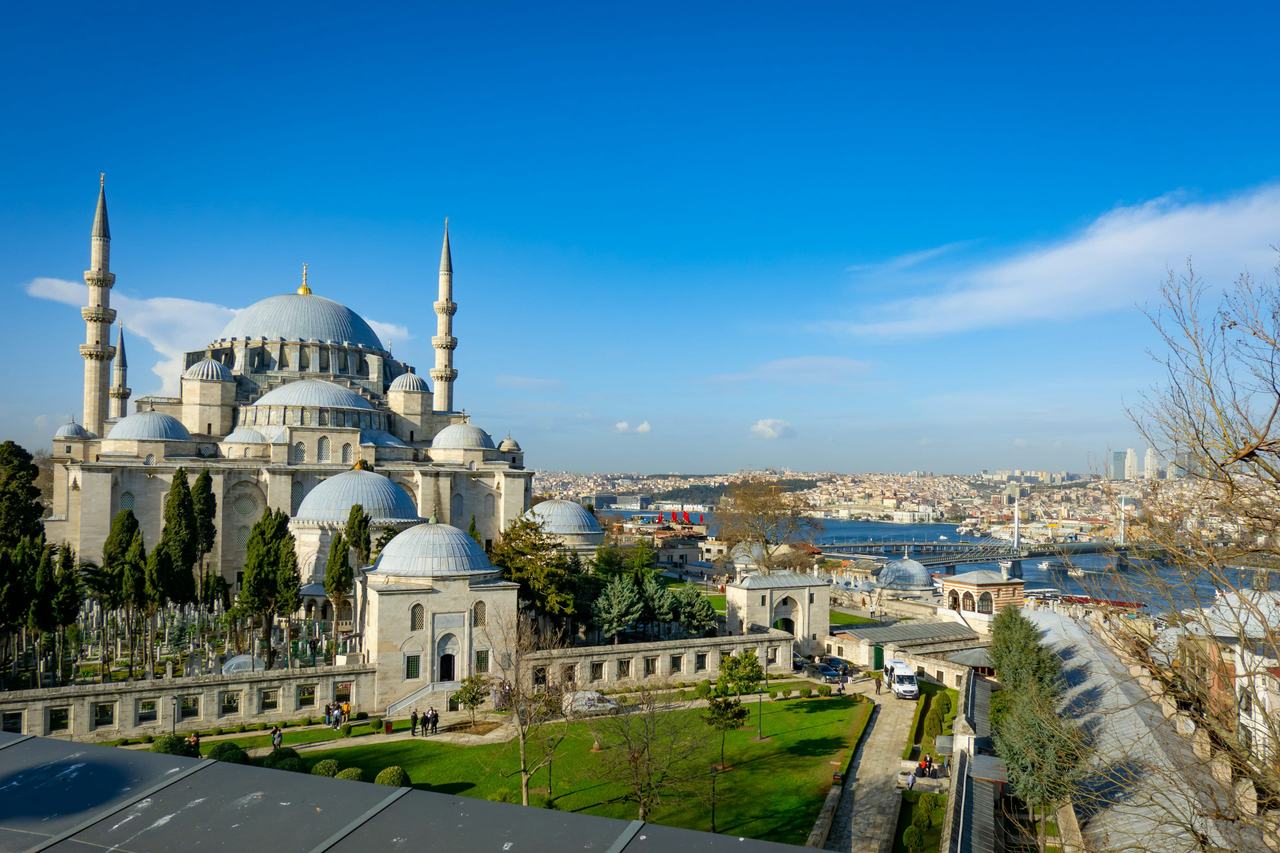
Built from 1550 to 1557 by the architect Sinan for Suleiman the Magnificent, the Süleymaniye overlooks the Golden Horn from Istanbul’s third hill. Around it spreads its complex – schools, hospital, baths – and, in the garden, the tombs of Suleiman and Roxelana.
The story
The Süleymaniye Mosque stands on Istanbul’s Third Hill, overlooking the Golden Horn, where Suleiman the Magnificent commissioned Mimar Sinan to build his imperial mosque. Its entrance inscription records the foundation in 1550 and inauguration in 1557, though construction of the surrounding complex continued afterward. Sinan’s design recalls Hagia Sophia, linking the sultan’s foundation to an established architectural symbol of sovereignty. The mosque formed the center of a religious and charitable complex that included schools, a public kitchen, and a hospital; behind its prayer wall, separate mausoleums hold Suleiman and his wife, Hurrem Sultan.
Did you know?
-
The mosque occupied the site of the old Ottoman palace, which was still in use and had to be demolished to make way for the new foundation.
-
A fire damaged the mosque in 1660, and an earthquake caused part of its dome to collapse in 1766.
Later cleaning revealed that Sinan had experimented with blue before making red the dome’s dominant decorative color.
On site, look closely
-
The great dome
Beneath the dome, 53 meters high, the prayer hall is bathed in light from a great many windows.
-
Suleiman and Roxelana
Behind the mosque, in the garden, stand the octagonal tombs of Suleiman the Magnificent and his wife Hürrem Sultan.
-
Sinan’s tomb
At a corner of the complex, the architect Mimar Sinan, who built the mosque, rests in a modest tomb he designed himself.