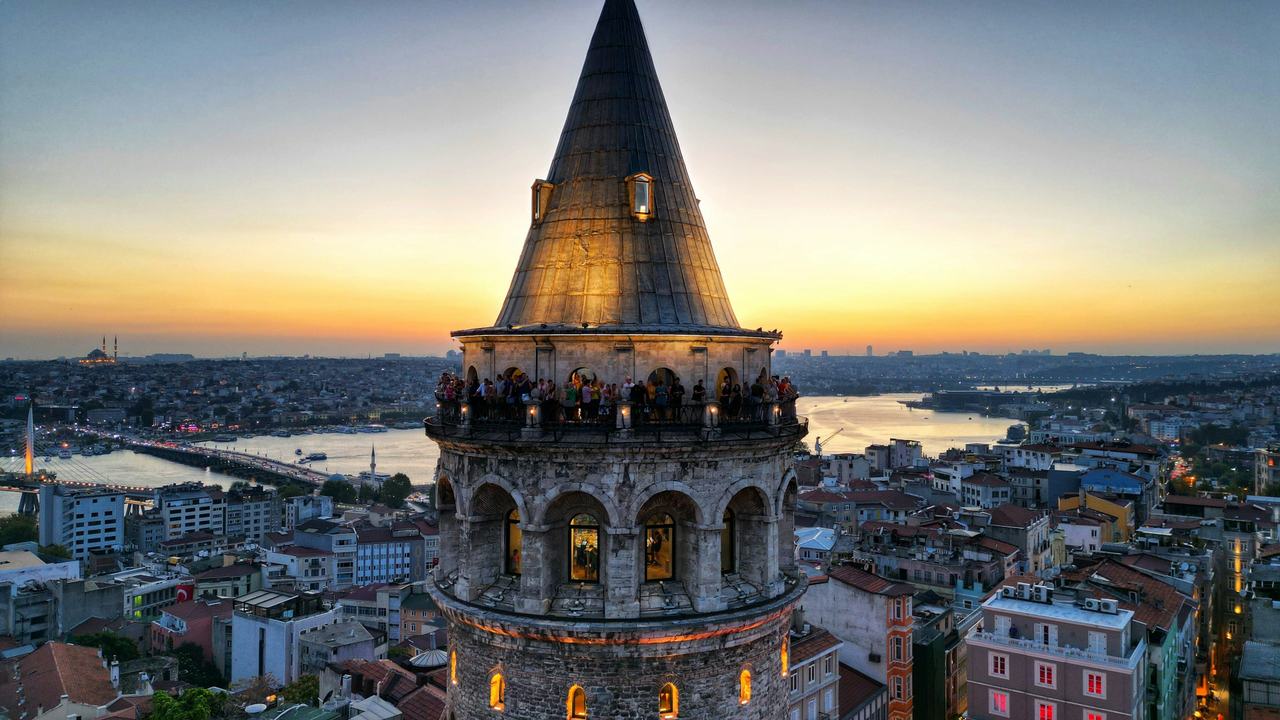
Built in 1348 by the Genoese at the highest point of their Galata colony, the tower served as a fire lookout before becoming a museum. Its circular balcony, some fifty meters up, takes in the Golden Horn, the Bosphorus and the old city.
The story
Galata Tower was built by the Genoese in 1348 as the principal tower of the fortifications protecting their colony of Pera, north of the Golden Horn. Its cylindrical stone shaft, built in the Romanesque style, survived the Ottoman takeover in 1453, when Sultan Mehmed II halted its destruction and damaged sections were rebuilt. The tower later housed prisoners of war and supplies before becoming a lookout for fires from the 18th century onward. Repeated fires, storms, and repairs reshaped its upper floors and roof; restoration in 1965–1967 gave it a conical roof resembling an earlier design. Converted into a museum and exhibition venue in 2020, it also retains an observation terrace overlooking Istanbul.
Did you know?
-
The Genoese called it the “Tower of the Holy Cross,” after the cross that once stood at its summit.
-
After a fire in 1794, repairs brought an unexpected change of use
The tower’s upper section became a coffeehouse.
On site, look closely
-
The circular balcony
At the very top, the narrow balcony runs all around the tower: the Golden Horn, the Bosphorus and the minarets of the old city follow one another.
-
A Genoese tower
It was raised in 1348 by the Genoese, who then held the Galata quarter, facing Constantinople.
-
The legend of Hezarfen
In the 17th century, according to the traveler Evliya Çelebi, Hezarfen Ahmed Çelebi is said to have launched himself from here on wings to cross the Bosphorus.