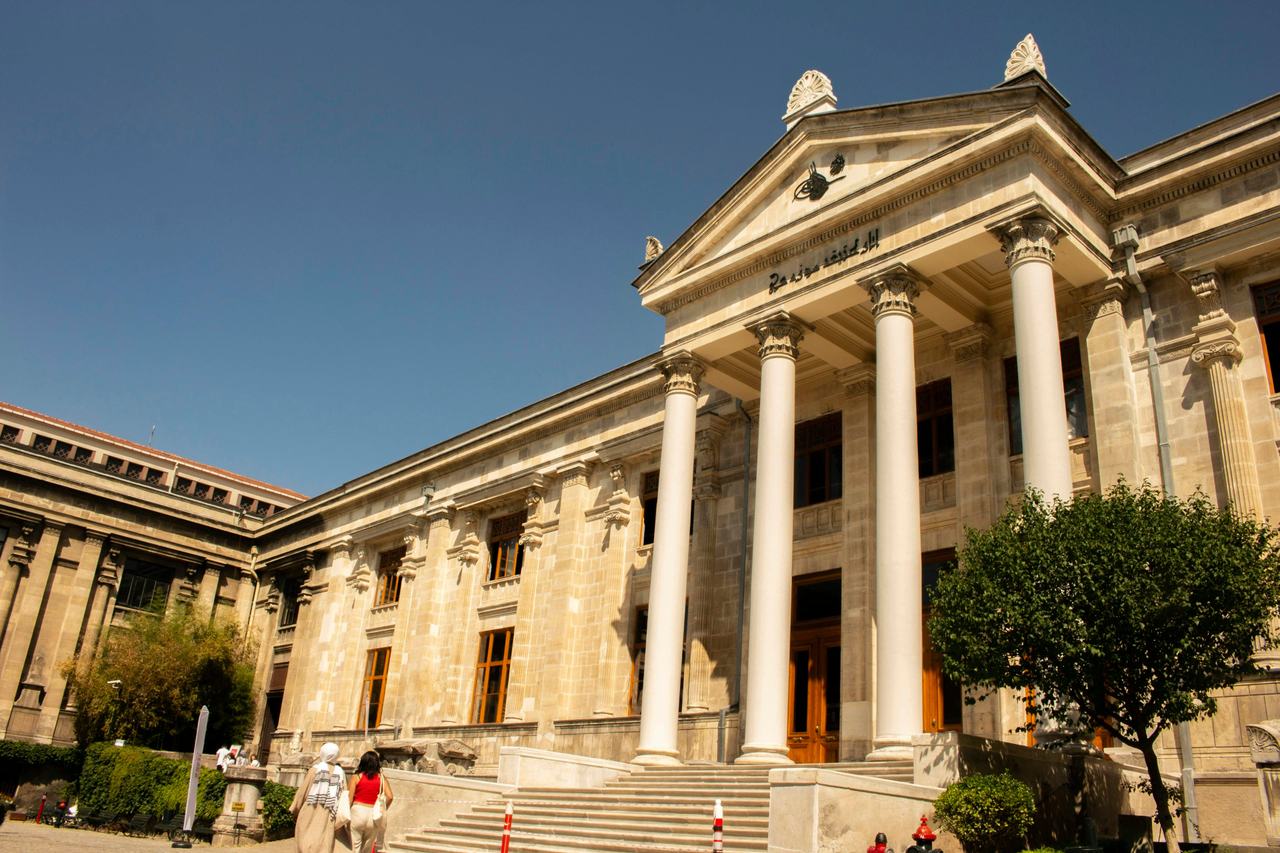
Founded by Osman Hamdi Bey and opened in 1891, the Istanbul Archaeology Museums bring together three buildings: the Archaeological Museum, the Museum of the Ancient Orient and the Tiled Kiosk. They hold the so-called Alexander Sarcophagus, found at Sidon, and a tablet of the Treaty of Kadesh.
The story
The Istanbul Archaeology Museums near Topkapı Palace grew from Ottoman collections once stored in Hagia Irene, which were formally established as the Imperial Museum in 1869. As antiquities arrived from across the empire, the collection moved to the Tiled Kiosk and eventually required a purpose-built home. Under Osman Hamdi Bey’s leadership, the main museum building was designed by Alexander Vallaury and opened on June 13, 1891. The complex brings together the Archaeological Museum, the Museum of the Ancient Orient, and the Museum of Islamic Art in the Tiled Kiosk, housing over one million objects.
Did you know?
-
The main building’s facade was inspired by two objects housed inside
The Alexander Sarcophagus and the Sarcophagus of the Mourning Women.
-
The Museum of the Ancient Orient occupies a building commissioned by Osman Hamdi Bey in 1883 as a fine arts school; it opened as a museum in 1935.
On site, look closely
-
The Alexander Sarcophagus
Found at Sidon, this marble sarcophagus shows Alexander the Great in battle and on the hunt; traces of paint are still visible.
-
The Treaty of Kadesh
This clay tablet carries the Hittite version of the peace treaty concluded between Egypt and the Hittites in the 13th century BC.
-
The Tiled Kiosk
In the garden, the Çinili Köşk, a pavilion from 1472, is covered in blue and turquoise ceramic tiles.