



Istanbul in three layers
Under the old city, a cistern held up by 336 columns. At street level, a Roman racetrack. Above it all, domes fifteen centuries old. A walk through Sultanahmet, read from the bottom up.
Read the story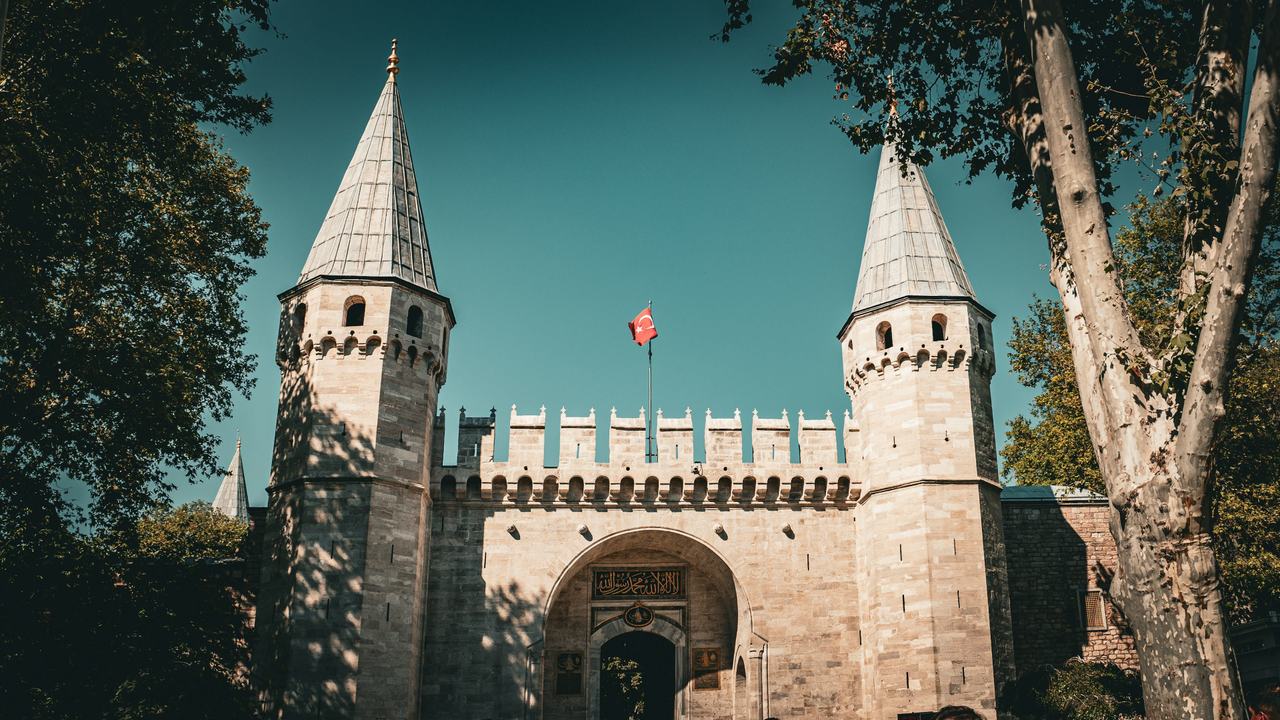
The Gate of Salutation at Topkapı Palace, its two conical towers among the trees · Photo by Syawish Rehman, Unsplash
Sources: National Palaces of Türkiye (Millî Saraylar) (booking, don’t miss); Lonely Planet, “Best things to do in Istanbul” (time needed, best time). Photo by Syawish Rehman, Unsplash.
More than a palace, a city within the city: a succession of courtyards, each more secret than the last, leading to the heart of the empire.
Topkapı Palace occupies the promontory where the Bosphorus meets the Sea of Marmara, overlooking the Golden Horn. Mehmed II ordered construction in 1459, establishing a complex of courtyards, pavilions, and private quarters that later sultans expanded while largely preserving his layout. Its four main courtyards organized the life of the Ottoman court, from government meetings in the Imperial Council building to the secluded household of the imperial harem. In 1856, Sultan Abdulmejid I moved the court to Dolmabahçe Palace, although Topkapı retained its treasury, library, and mint. A government decree transformed it into a museum in 1924, preserving both its imperial interiors and collections of manuscripts, clothing, weapons, and treasures.
Silence in the inner courtyards was part of court protocol.
Grilled windows and secret passageways helped protect the sultan’s privacy even within the palace.
The palace was originally called the Imperial New Palace to distinguish it from the Old Palace in Beyazıt.
Its present name, Topkapı, means “Cannon Gate.”
The Gate of Salutation
Its two pointed towers mark the entrance to the Second Courtyard. Beyond it, only the sultan was allowed to ride on horseback.
The Treasury
The Topkapı Dagger, set with emeralds, and the Spoonmaker’s Diamond, one of the largest in the world, are on display there.
The terraces
From the Fourth Courtyard, the view opens onto the Bosphorus and the Asian shore: save it for the end of your visit.
Too far to walk comfortably: take public transit.
Distances as the crow flies; walking times are estimates. Known places from Wikidata.