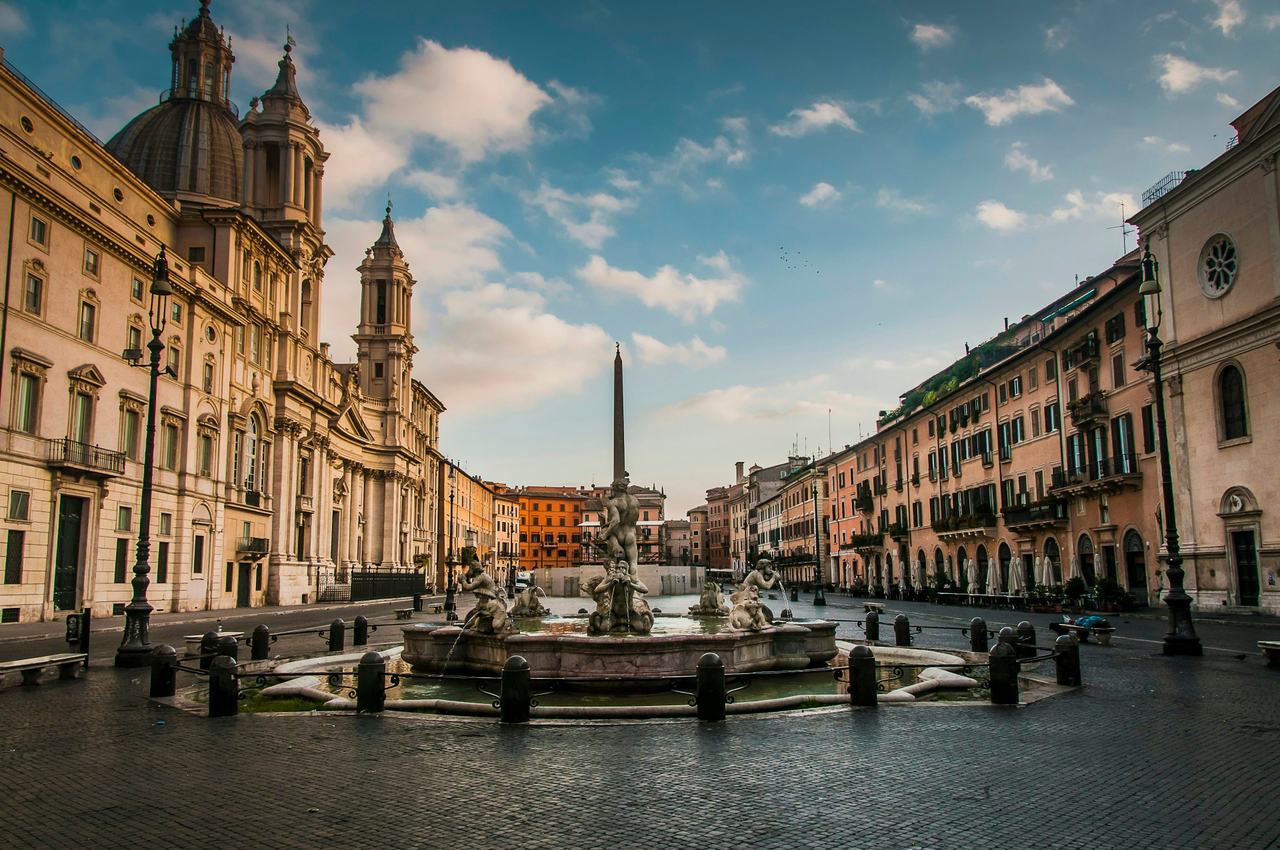
Built over the 1st-century Stadium of Domitian, whose long shape it keeps, Piazza Navona is Rome’s great Baroque drawing room. Bernini carved the Fountain of the Four Rivers here in 1651, facing Borromini’s church of Sant’Agnese in Agone.
The story
Piazza Navona preserves the elongated outline and rounded northern end of the stadium Emperor Domitian built in AD 85 for athletic contests. The former arena remained a setting for public entertainments, including Renaissance tournaments and Carnival festivities. In the 17th century, Pope Innocent X transformed it into a monumental showcase for his Pamphili family, commissioning a palace and reshaping the surrounding area. Three fountains organize the cobblestoned square, with Gian Lorenzo Bernini’s Fountain of the Four Rivers at its center facing Sant’Agnese in Agone, whose architects included Girolamo Rainaldi and Francesco Borromini.
Did you know?
-
The square was once deliberately flooded by blocking the outlets of its three fountains, allowing water to spread across its concave surface.
-
The obelisk above the central fountain was not part of the ancient stadium
It was brought from the Circus of Maxentius on the Appian Way.
On site, look closely
-
The Fountain of the Four Rivers
In the center, Bernini raised an obelisk on a rock surrounded by the Nile, the Ganges, the Danube and the Río de la Plata.
-
Sant’Agnese in Agone
Facing the fountain, Borromini’s concave facade turns the church into a stage set for the whole square.
-
The shape of the stadium
The square keeps exactly the elongated plan of Domitian’s stadium, whose remains can still be seen beneath the houses to the north.