The best-preserved monument of ancient Rome owes its survival to a conversion: turned into a church in the 7th century, it has never stopped being used.
The story
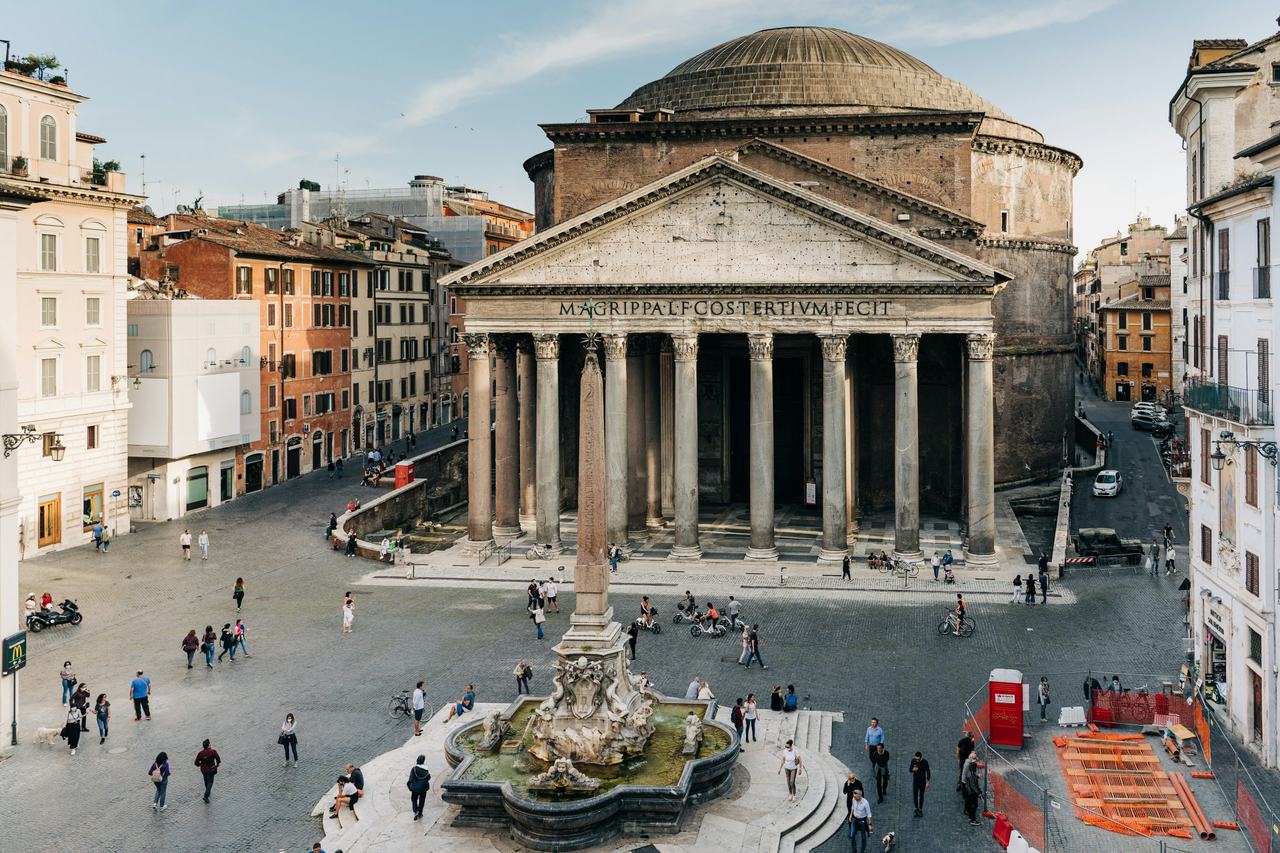
The Pantheon on Piazza della Rotonda preserves a Roman temple transformed into the Christian basilica of Santa Maria ad Martyres. Marcus Vipsanius Agrippa founded its predecessor in 27 BC; after fires destroyed the earlier building, Emperor Hadrian had it rebuilt, probably between about AD 112 and 128. Behind its Corinthian-columned portico, a circular hall rises beneath a concrete dome pierced by an open oculus that admits daylight. In the early seventh century, the Eastern emperor Phocas gave the building to Pope Boniface IV, and its conversion into a church helped it survive the stripping suffered by other ancient Roman monuments.
Did you know?
-
The inscription across the portico credits Agrippa rather than Hadrian
Agrippa’s original dedication was repeated on the rebuilt temple.
-
The height to the oculus equals the circular hall’s diameter, so an imaginary sphere would fit inside.
The dome remains the largest in the world built of unreinforced concrete.
On site, look closely
-
The oculus
The opening at the top of the dome is the only source of light. When it rains, the water falls into the hall and drains away through small holes in the floor.
-
The coffers
The recesses lining the dome are not just decoration: they lighten the vault while setting a perfect rhythm toward the light.
-
Piazza della Rotonda
In front of the portico stands a Renaissance fountain topped by an Egyptian obelisk. The finest view of the monument is from its steps.