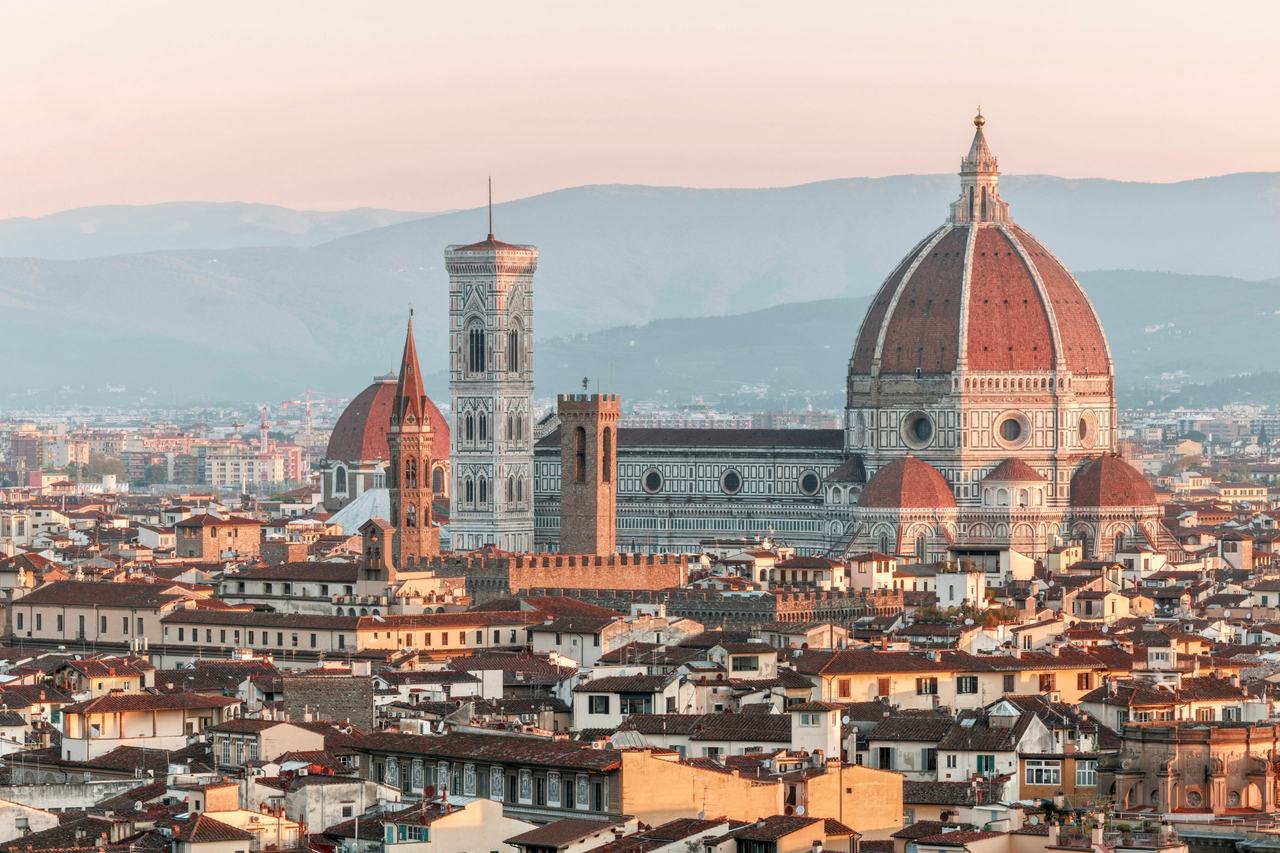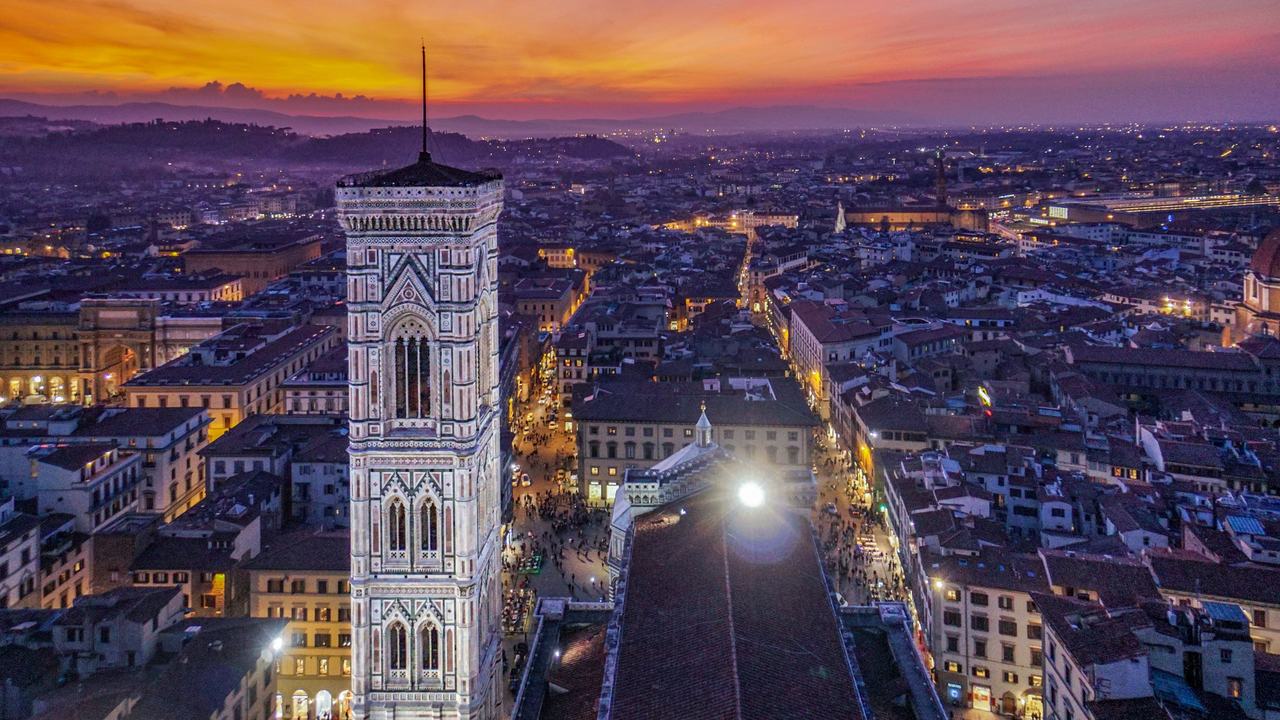
Giotto began the cathedral’s bell tower in 1334; Andrea Pisano and then Francesco Talenti completed it in 1359. Nearly 85 meters high, it is climbed by 414 steps, with no lift, to a terrace facing Brunelleschi’s dome.
The story
Giotto's Campanile stands beside Florence Cathedral, aligned with its facade rather than tucked behind it. Its foundations were excavated around 1298, but Giotto took charge in 1334 and had completed only the first stage when he died in 1337. The tower's white, green, and red marble cladding and the sculptural program around its base express his conception, although no individual relief has been securely identified as his own work. His documented successor, Andrea Pisano, strengthened and modified the structure, directing construction from 1337 to 1348 and adding pointed niches for freestanding sculptures that could be seen more readily from below.
Did you know?
-
Giotto planned a pyramidal spire that would have brought the tower's total height to roughly 120–125 meters; the tower as built reaches 85 meters.
-
The staircase was built within the thickness of the walls rather than projecting into the central shaft.
This left spacious interior rooms but weakened the tower's original base.
On site, look closely
-
The 414 steps
With no lift, the staircase climbs to the terrace, more than 80 meters up, where Brunelleschi’s dome is almost at eye level.
-
The reliefs at the base
The carved hexagons tell of humanity’s arts and trades; those in place are copies, the originals are in the Museo dell’Opera del Duomo.
-
Three-colored marble
White Carrara, green Prato and red Maremma marble dress the tower in the same pattern as the neighboring cathedral.