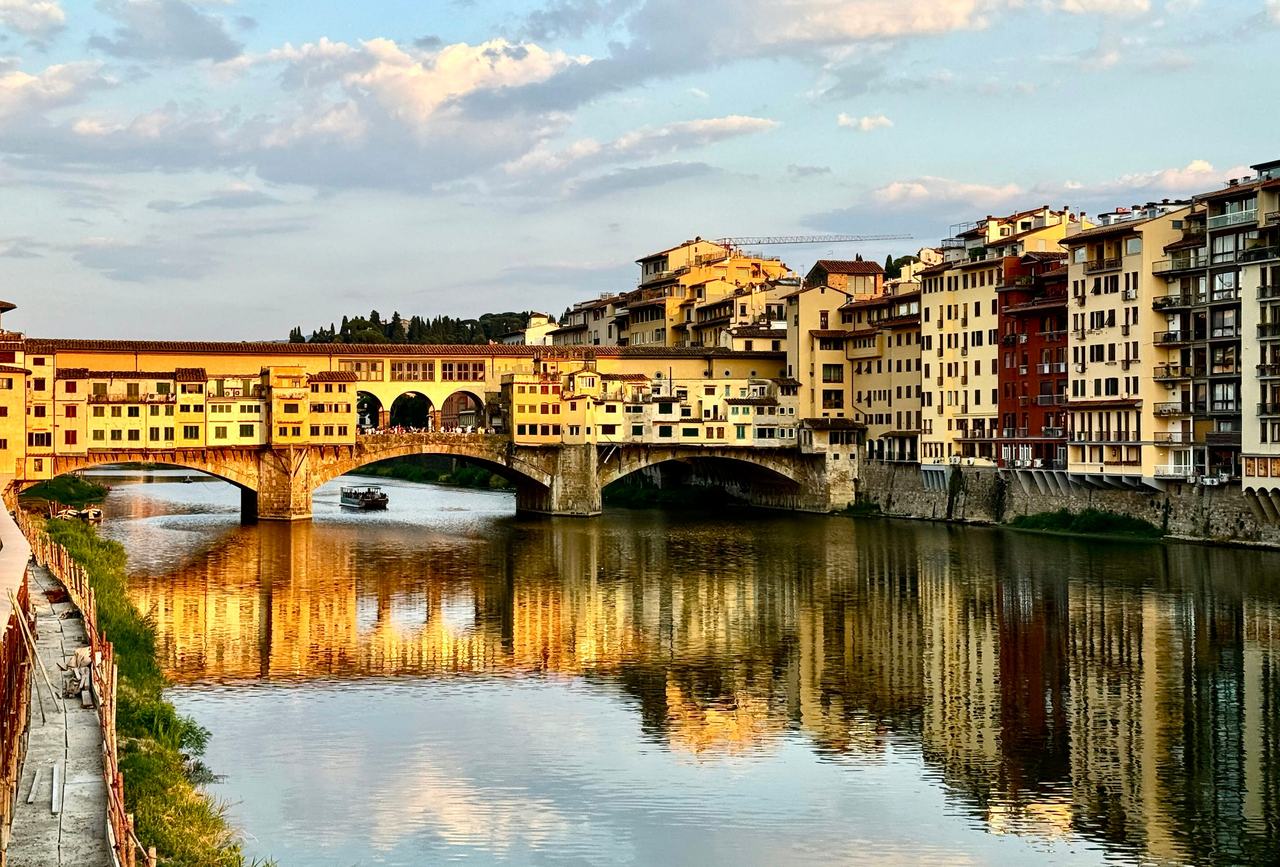
Rebuilt in 1345 after a flood of the Arno, the Ponte Vecchio is the oldest bridge in Florence. Its shops have been reserved for goldsmiths since 1593; above runs the Vasari Corridor, built in 1565 to link the Palazzo Vecchio to the Palazzo Pitti.
The story
Ponte Vecchio spans the Arno at a crossing whose history probably reaches back to Roman times. The present bridge was built between about 1339 and 1345 after the devastating flood of 1333 swept away its predecessor; its designer remains uncertain. Its three arches originally supported four elongated, battlemented buildings arranged around a central open space. Small shops gradually filled the spaces along both sides, replacing temporary market stalls and giving the crossing its distinctive built-up appearance.
Did you know?
-
Two surviving stone inscriptions commemorate the bridge’s completion in 1345.
-
Despite its name, meaning “Old Bridge,” Ponte Vecchio became Florence’s oldest surviving bridge only in 1944, when the older Ponte di Rubaconte was blown up.
On site, look closely
-
The jewelers
In 1593 Grand Duke Ferdinando I drove the butchers off the bridge to bring in goldsmiths: their overhanging shops are still there.
-
The corridor above
Above the shops runs the Vasari Corridor, which let the Medici cross the Arno without mixing with the crowd.
-
The bust of Cellini
In the middle of the bridge, an opening onto the river frames the bust of the goldsmith Benvenuto Cellini, set up in 1901.