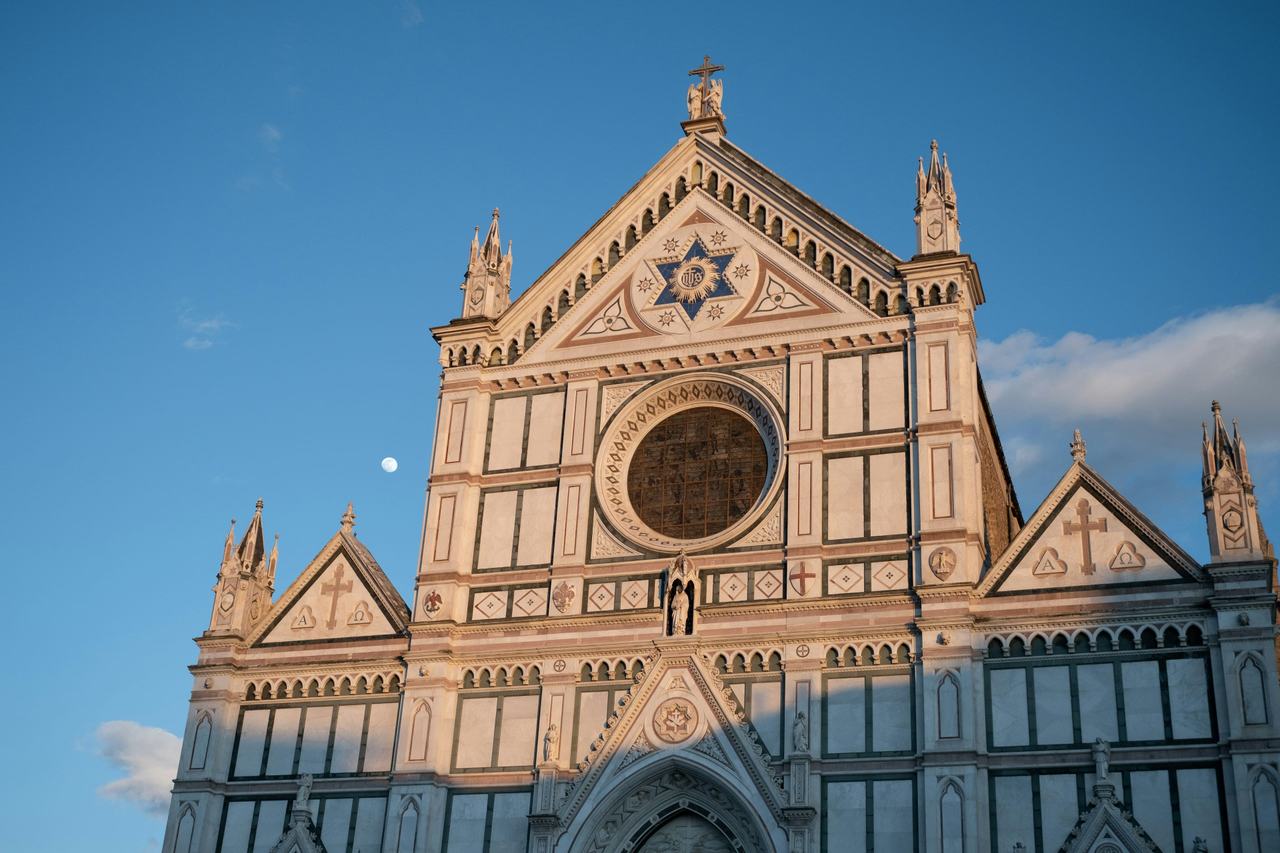
Begun in 1294, Santa Croce is the largest Franciscan church in the world. People come for the tombs of Michelangelo, Galileo and Machiavelli, for Giotto’s frescoes and for Brunelleschi’s Pazzi Chapel.
The story
The Basilica of Santa Croce was begun in 1294 to replace a church that had become too small for Florence’s Franciscan community, with an ambitious Gothic design traditionally attributed to Arnolfo di Cambio. Funded by the people of the Florentine Republic, it was usable by 1320 but was not consecrated until 1443. From 1566, at Cosimo I de’ Medici’s direction, its interior was reshaped for Counter-Reformation worship, removing the choir screen and introducing large stone altars designed by Giorgio Vasari. With the tombs of Michelangelo, Galileo, and Machiavelli, it later became a national pantheon, an identity strengthened by Ugo Foscolo’s celebration of it in his poem Dei sepolcri.
Did you know?
-
Dante’s monumental memorial here is a cenotaph
Ravenna refused to surrender the remains of the poet, who had died in exile.
-
The devastating Florence flood of 1966 also exposed part of the basilica’s earlier history
After its floor gave way, remains of the preceding church were located.
On site, look closely
-
The tombs
Michelangelo, Galileo and Machiavelli lie in the nave, and a cenotaph honors Dante; the church is nicknamed the temple of Italian glories.
-
Giotto’s frescoes
In the Bardi and Peruzzi chapels, to the right of the choir, Giotto painted the life of Saint Francis and of the two Saints John.
-
The Pazzi Chapel
In the first cloister, Brunelleschi’s small chapel is a model of harmony: gray stone, white walls and simple proportions.