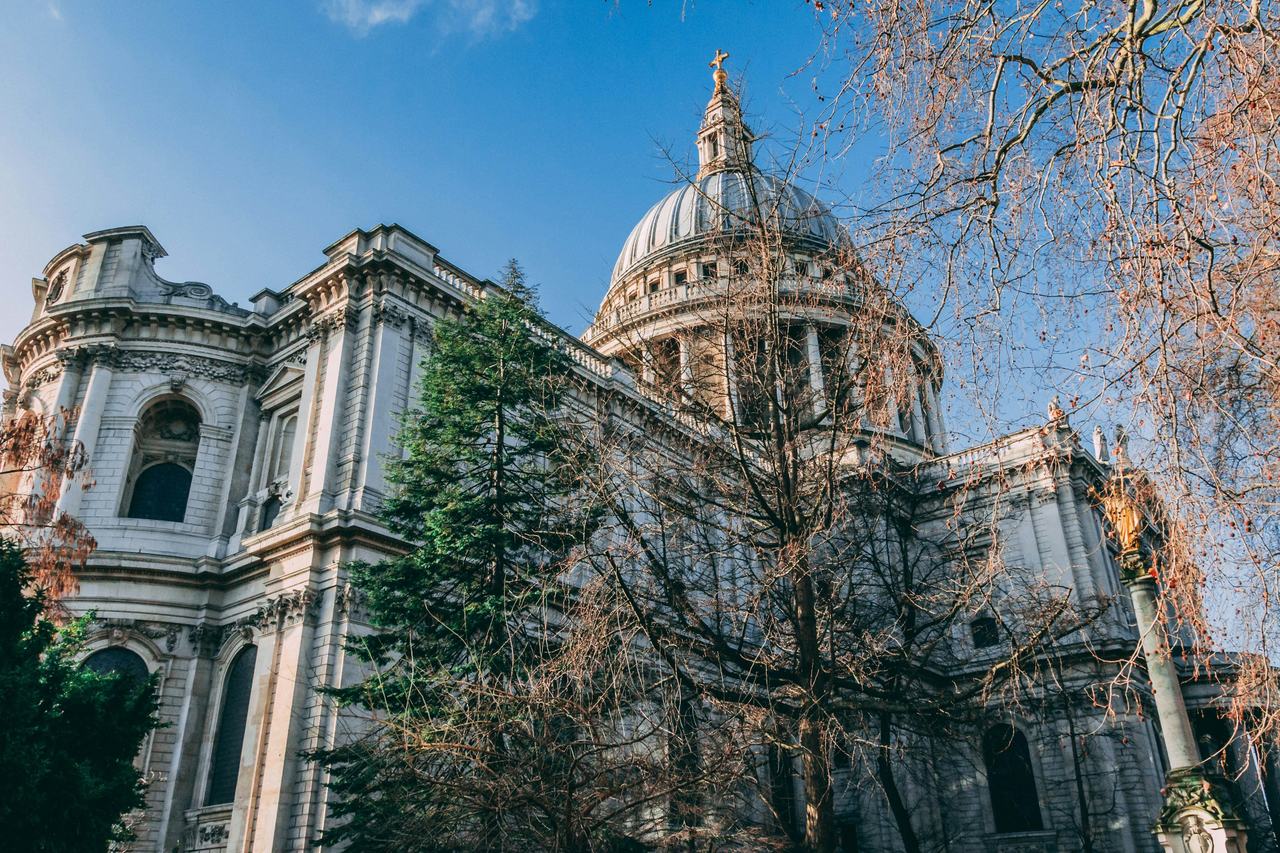
Rebuilt by Christopher Wren after the Great Fire of 1666, St Paul’s Cathedral was completed in 1710. Its dome, 111 meters high, can be climbed all the way to the Golden Gallery; the crypt holds the tombs of Nelson, Wellington and Wren himself.
The story
St. Paul's Cathedral stands on Ludgate Hill as the seat of the bishop of London and the mother church of the Diocese of London. Designed by Sir Christopher Wren in the English Baroque style, the present building was completed in 1710 as part of the rebuilding that followed the Great Fire of London, which largely destroyed its Gothic predecessor. Its great dome became a defining feature of London's skyline, while the cathedral became a setting for national mourning and celebration, including Winston Churchill's funeral and the wedding of Prince Charles and Lady Diana Spencer. Alongside this public role, it remains a working Anglican church with daily services.
Did you know?
-
At 365 feet high, St. Paul's was London's tallest building from 1710 until 1963.
-
The antiquarian William Camden believed a Roman temple to Diana had occupied the site.
Wren found no trace of it during construction, and modern archaeologists no longer accept the theory.
On site, look closely
-
The Whispering Gallery
Inside the dome, a word whispered against the wall can be heard clearly on the other side of the gallery, some thirty meters away.
-
The crypt
Christopher Wren, the architect, lies beneath a plain slab; the inscription tells visitors to look around them if they seek his monument. Nelson and Wellington are buried nearby.
-
The Golden Gallery
At the very top of the dome, after 528 steps, the small outer gallery looks out over the City and the Thames.