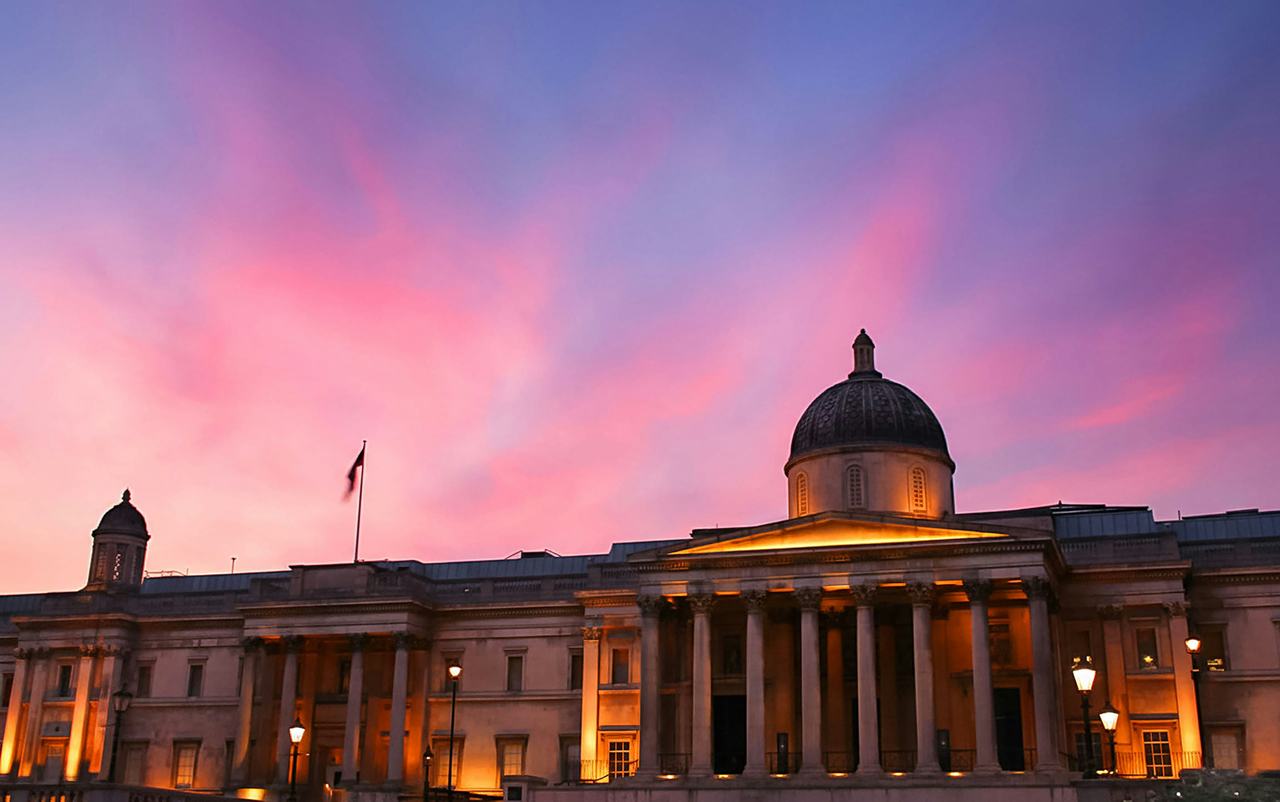
Founded in 1824, the National Gallery has stood on the north side of Trafalgar Square since 1838. Its collection of more than 2,300 paintings tells the story of European painting from the 13th century to the early 20th.
The story
The National Gallery in Trafalgar Square grew from the British government’s purchase of 38 paintings from the heirs of banker John Julius Angerstein in 1824. Initially housed in his former townhouse on Pall Mall, the collection moved into William Wilkins’s purpose-built gallery in 1838. Successive expansions transformed the building behind its largely unchanged Trafalgar Square facade, including the Sainsbury Wing, completed in 1991 to designs by Robert Venturi and Denise Scott Brown. The collection traces Western European painting from the mid-13th century to 1900, and admission to the main collection is free.
Did you know?
-
An unexpected repayment of a war debt by Austria helped prompt the government to buy Angerstein’s collection for £57,000.
-
Space shortages in the gallery helped lead to the establishment of the Tate Gallery for British art in 1897.
On site, look closely
-
Sunflowers
One of Van Gogh’s versions of Sunflowers, painted in Arles in 1888, lights up a room devoted to the late 19th century.
-
The Arnolfini Portrait
In Van Eyck’s painting of 1434, the small mirror at the back reflects the couple from behind and two figures entering the room.
-
The Fighting Temeraire
Turner painted it in 1839: an old warship towed to the breakers by a small steam tug, under a blazing sunset.