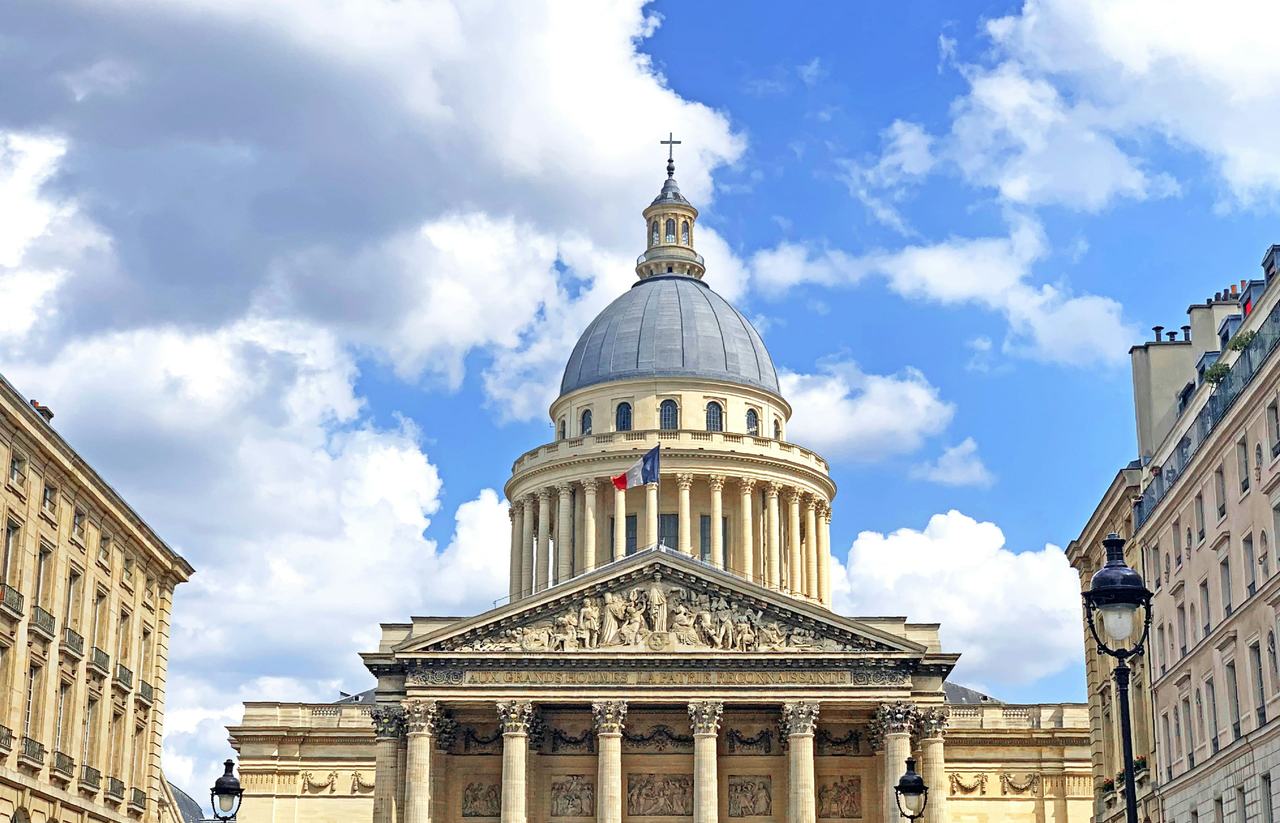
Commissioned by Louis XV and built by Soufflot from 1764 on the Montagne Sainte-Geneviève, the Panthéon became in 1791 the tomb of the nation’s great figures. Beneath its dome, Foucault’s pendulum recalls the 1851 experiment that made the Earth’s rotation visible.
The story
The Panthéon stands on the Montagne Sainte-Geneviève in Paris’s Latin Quarter, built between 1758 and 1790 as a church dedicated to the city’s patron saint. Commissioned by Louis XV, it was designed by Jacques-Germain Soufflot, who sought to combine the lightness of Gothic architecture with classical forms; after his death, his pupil Jean-Baptiste Rondelet completed the building. In 1791, the revolutionary assembly transformed the newly finished church into a mausoleum for distinguished French citizens, and windows were blocked to give its interior a more funerary atmosphere. It returned to religious use twice during the nineteenth century before its exclusive role as a mausoleum was established in 1881, followed by Victor Hugo’s burial in the crypt in 1885.
Did you know?
-
In 1851, Léon Foucault suspended a pendulum from the ceiling to demonstrate the Earth’s rotation.
A copy remains visible inside.
-
What appears from outside to be a single dome is actually three nested domes.
An opening in the lowest reveals Antoine Gros’s painting of the Apotheosis of Saint Genevieve on the dome above.
On site, look closely
-
Foucault’s pendulum
Beneath the dome swings the pendulum with which Léon Foucault proved the rotation of the Earth before the public in 1851.
-
The crypt
Voltaire, Rousseau, Victor Hugo, Zola, Marie Curie, Simone Veil: the great figures honored by the Nation rest beneath the nave.
-
The colonnade
In the warmer months, the gallery around the dome opens to visitors: all of Paris spreads out around the Latin Quarter.