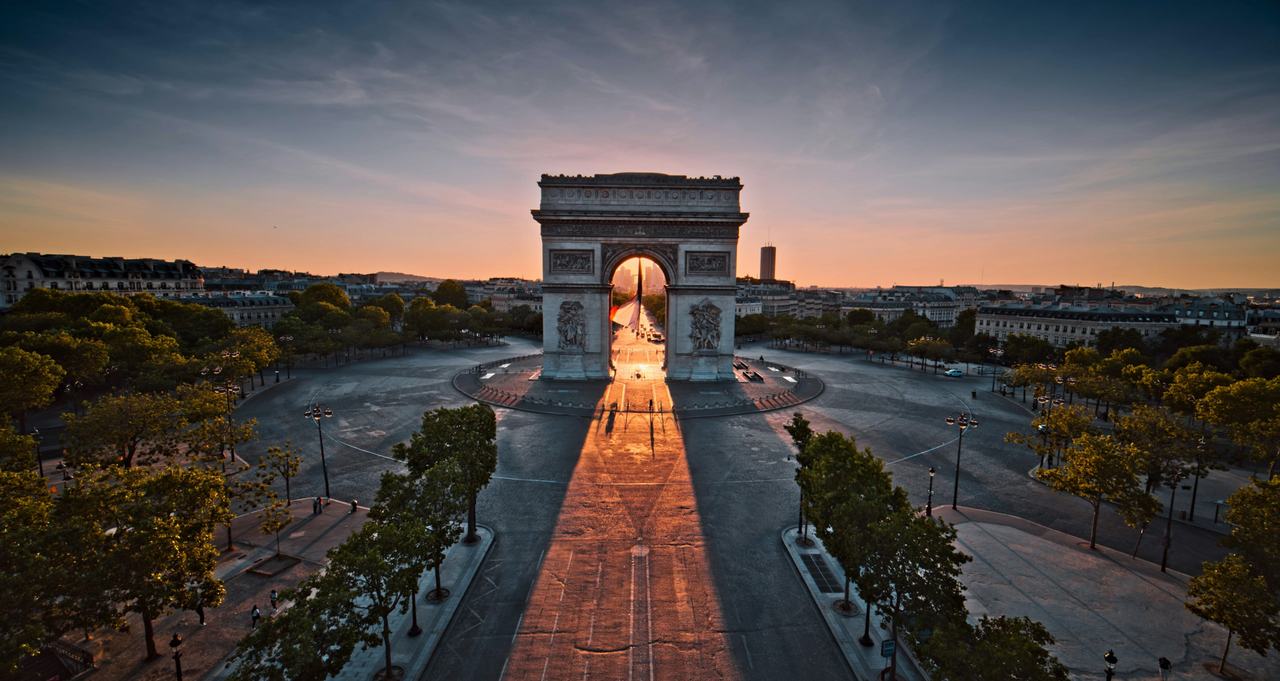
Commissioned by Napoleon in 1806, after the victory at Austerlitz, and inaugurated in 1836, the Arc de Triomphe towers over Place Charles-de-Gaulle, where twelve avenues meet. The Unknown Soldier has lain beneath its vault since 1921, and his flame is rekindled every evening.
The story
The Arc de Triomphe stands at the centre of Place Charles de Gaulle, at the western end of the Champs-Élysées. Napoleon commissioned it in 1806 after his victory at Austerlitz, to honour those who fought and died for France in the Revolutionary and Napoleonic Wars. Designed by Jean-François Chalgrin and inspired by Rome’s Arch of Titus, it was completed in 1836 under Louis-Philippe, after interruptions and changes of architect. Names of victories and generals cover its surfaces, while beneath its vault the Tomb of the Unknown Soldier from the First World War, marked by an eternal flame, gives the triumphal monument a role of national mourning.
Did you know?
-
When Napoleon entered Paris with his new bride, Marie-Louise of Austria, in 1810, the arch was still unfinished.
A wooden mock-up of the completed monument was built for their arrival.
-
On 7 August 1919, Charles Godefroy flew a Nieuport biplane through the arch’s main vault.
The flight was captured on newsreel.
On site, look closely
-
The Tomb of the Unknown Soldier
Beneath the vault lies, since 1921, a soldier of the Great War; his flame is rekindled every evening at 6:30 p.m.
-
Rude’s Marseillaise
On the pillar facing the Champs-Élysées, the Departure of the Volunteers of 1792 shows a winged Victory shouting and leading the soldiers on.
-
The terrace
After 284 steps, the terrace looks down on the star of twelve avenues: the Champs-Élysées axis to the Louvre on one side, La Défense on the other.