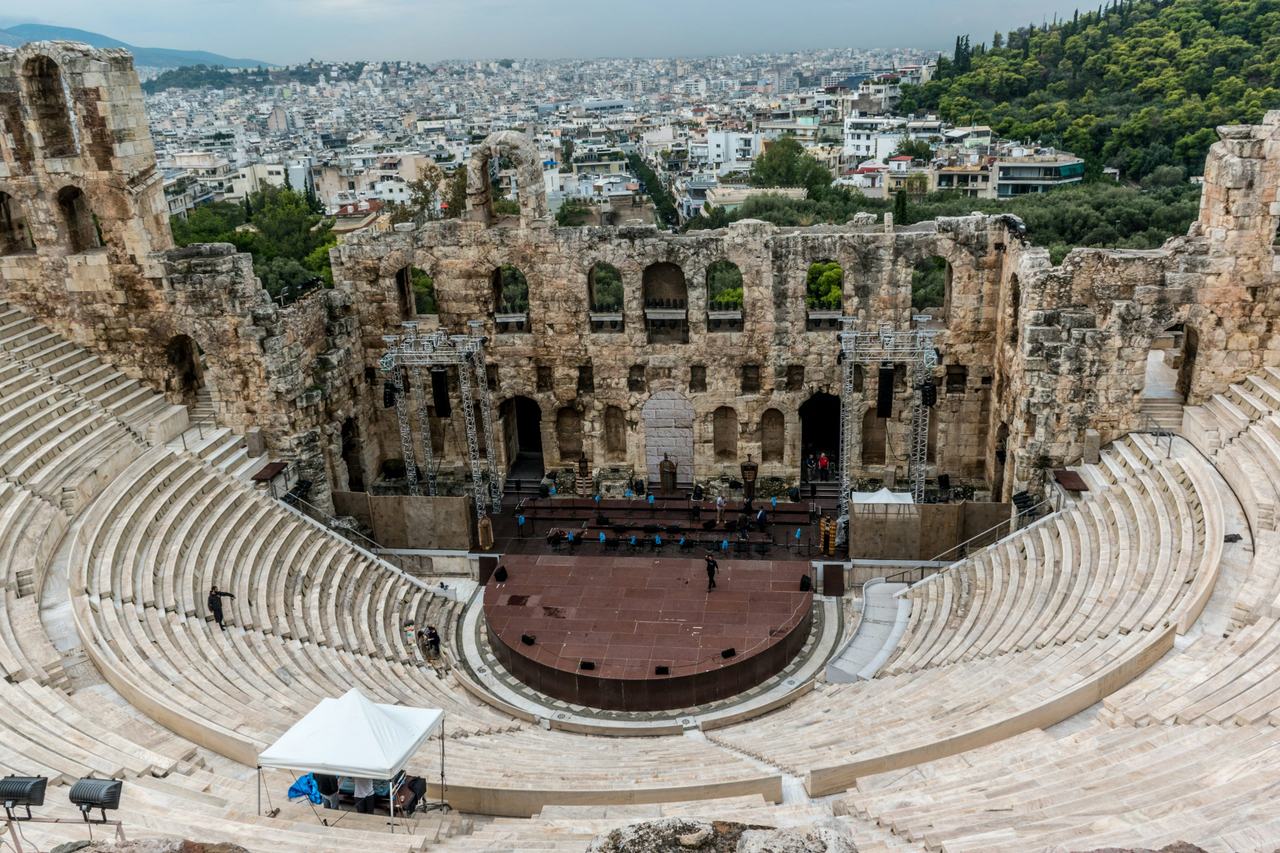
Herodes Atticus had this odeon built around AD 161 in memory of his wife Regilla. Restored in the 1950s, it hosts the performances of the Athens Festival every summer, beneath the rock of the Acropolis.
The story
The Odeon of Herodes Atticus stands at the southwestern foot of the Acropolis, built in the second century AD as a memorial to Regilla, the wife of the wealthy Greek orator Herodes Atticus. Intended for musical performances, it was burned during the Herulian sack of Athens in AD 267–268, and its ruins were later incorporated into successive city fortifications. Organized excavations began in 1849, followed by extensive work from 1856 that uncovered the seating tiers. The odeon has since returned to use as a performance venue and is a principal setting for the Athens Epidaurus Festival.
Did you know?
-
Although it is open to the sky today, the ancient odeon had a cedar roof, singled out for admiration by the writer Philostratus.
-
After centuries of burial and alteration, the building became so difficult to recognize that a 14th-century Italian traveler mistook its remains for an old bridge.
On site, look closely
-
A theater in memory
Herodes Atticus, a wealthy Athenian, had it built in 161 in memory of his wife Regilla; a cedar roof covered it at the time.
-
Still on stage
In summer, the Athens Festival stages concerts, opera and theater here under the stars, before nearly five thousand spectators.
-
The view from above
The best view of its tiers and stage wall is from the path climbing up to the Acropolis.