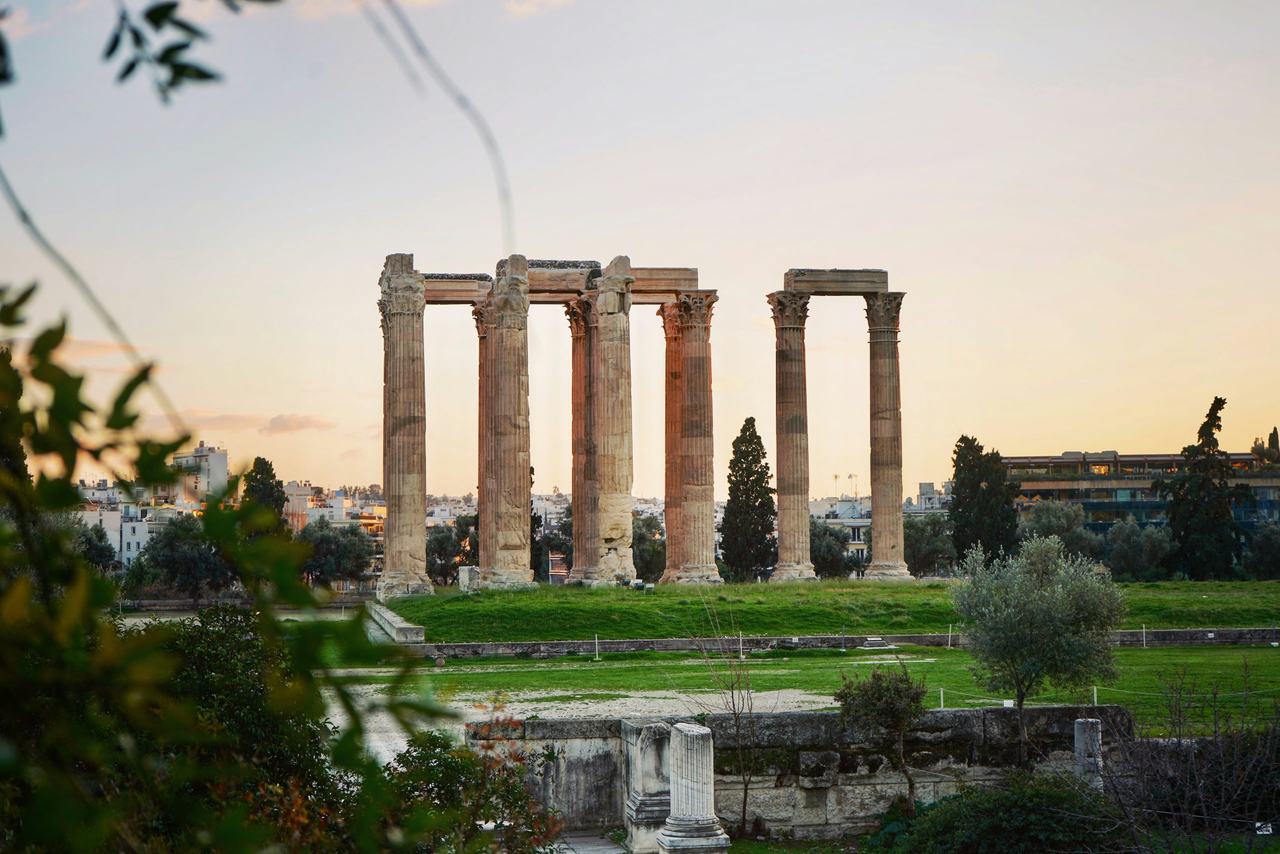
Begun in the 6th century BC, the temple was completed only under the emperor Hadrian, around AD 131–132, more than six centuries later. Of the original 104 columns, fifteen still stand; a sixteenth has lain on the ground since a storm in 1852.
The story
The Temple of Olympian Zeus began around 520 BC as a project of the Athenian rulers Hippias and Hipparchos, who intended it to surpass the great temples of Samos and Ephesus. Construction stopped after their tyranny fell, and the unfinished building stood for centuries before King Antiochus IV revived the project in 174 BC, with the Roman architect Decimus Cossutius replacing the original Doric scheme with a Corinthian design in Pentelic marble. Emperor Hadrian finally dedicated the temple in AD 132; its 104 colossal columns surrounded a sanctuary housing a monumental gold-and-ivory statue of Zeus. Pillaged during a Germanic invasion in AD 267 and later quarried for building materials, the temple survives as a ruin whose remaining columns reveal the scale of the undertaking.
Did you know?
-
Aristotle cited the unfinished temple in his Politics as an example of how tyrants used enormous public works to keep their subjects too occupied and impoverished to rebel.
-
During his sack of Athens in 86 BC, Sulla took some of the unfinished temple’s columns to Rome, where they were reused in the Temple of Jupiter on the Capitoline Hill.
On site, look closely
-
The giant columns
Of the one hundred and four Corinthian columns, more than fifteen meters tall, fifteen still stand and give the scale of the largest temple in Greece.
-
The fallen column
A sixteenth column lies on the ground, its drums lined up like coins: it fell in a storm in 1852.
-
Hadrian’s Arch
At the entrance, the arch bears two inscriptions: on one side the city of Theseus, on the other that of Hadrian, the emperor who completed the temple.