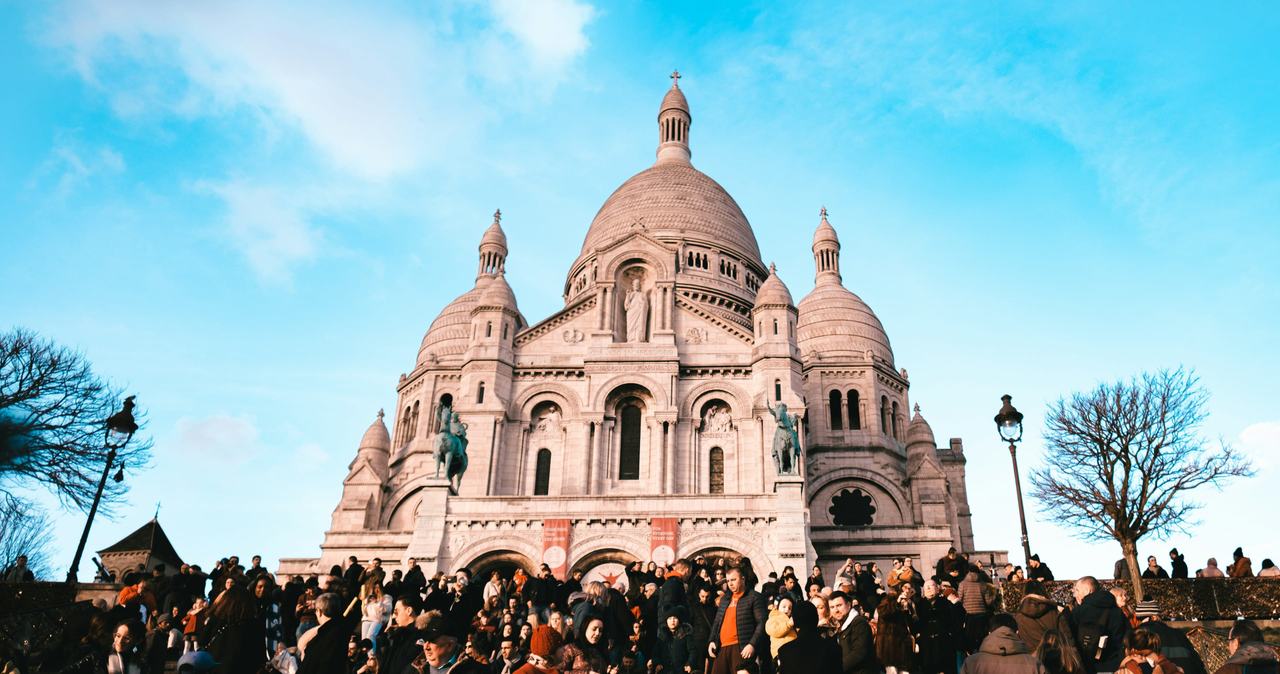
Begun in 1875 on the hill of Montmartre, completed in 1914 and consecrated in 1919, the Sacré-Cœur owes its whiteness to Château-Landon stone, which bleaches in the rain. Above the choir, its mosaic of Christ in Glory is one of the largest in France.
The story
The Basilica of Sacré-Cœur crowns Montmartre in northern Paris, its dome rising above a hill long associated with religious worship. Its origins lie in a vow made by the philanthropist Alexandre Legentil amid France’s defeat in the Franco-Prussian War: he promised to help establish a Paris sanctuary dedicated to the Sacred Heart of Jesus as an act of repentance and an appeal for divine help. With his brother-in-law, the painter Hubert Rohault de Fleury, he developed the undertaking into a national campaign, and the National Assembly declared the church a work of public utility in 1873. Officially completed in 1923, the basilica embodies both Catholic devotion and the political tensions surrounding France’s recovery from the war.
Did you know?
-
The founding vow was made not in Paris but in Poitiers, where Legentil spoke to his confessor in the chapel of Saint-Joseph College in December 1870.
-
Although it is a Catholic sanctuary, the basilica belongs to the City of Paris.
On site, look closely
-
The apse mosaic
Above the choir, a Christ with open arms dominates one of the largest mosaics in France.
-
The stone that stays white
The basilica is built of Château-Landon stone: when it rains, it releases calcite that keeps it white.
-
The dome
By a staircase of some three hundred steps, the dome gallery offers one of the highest views over all of Paris.