Finishing Gaudí
Antoni Gaudí died in 1926 with less than a quarter of the Sagrada Família built, and his models were smashed ten years later. How do you finish a church whose architect left only fragments?
When Antoni Gaudí died in June 1926, the Sagrada Família was between 15 and 25 percent complete. He knew he would never see it finished; he is said to have remarked that his client was not in a hurry. What he could not know was that ten years later most of what he left behind would be destroyed, and that the church would have to be finished from fragments.
A workshop in pieces
Construction began on March 19, 1882, under another architect, Francisco de Paula del Villar. Gaudí took over the following year and gave the church the rest of his life. He worked less from drawings than from large plaster models, built in a workshop on the site. In July 1936, at the start of the Spanish Civil War, the crypt was set on fire and the workshop broken into. Plans burned and the models were smashed.
The pieces were kept. For decades, the architects who followed fitted fragments back together and filled the gaps with published drawings and old photographs.
Geometry as a message
What made the reconstruction possible was the way Gaudí designed. In his last years he built the church out of ruled surfaces, forms such as hyperboloids that can be generated entirely from straight lines. A fragment of such a surface is enough to recover the whole, the way an arc is enough to redraw a circle.
Gaudí had left his instructions inside the shapes themselves.
Today those instructions are read by computers. The geometry is modeled on screen, and the stone is cut by machine away from the site before being lifted into place. For most of the twentieth century it was carved by hand.
The year of the tower
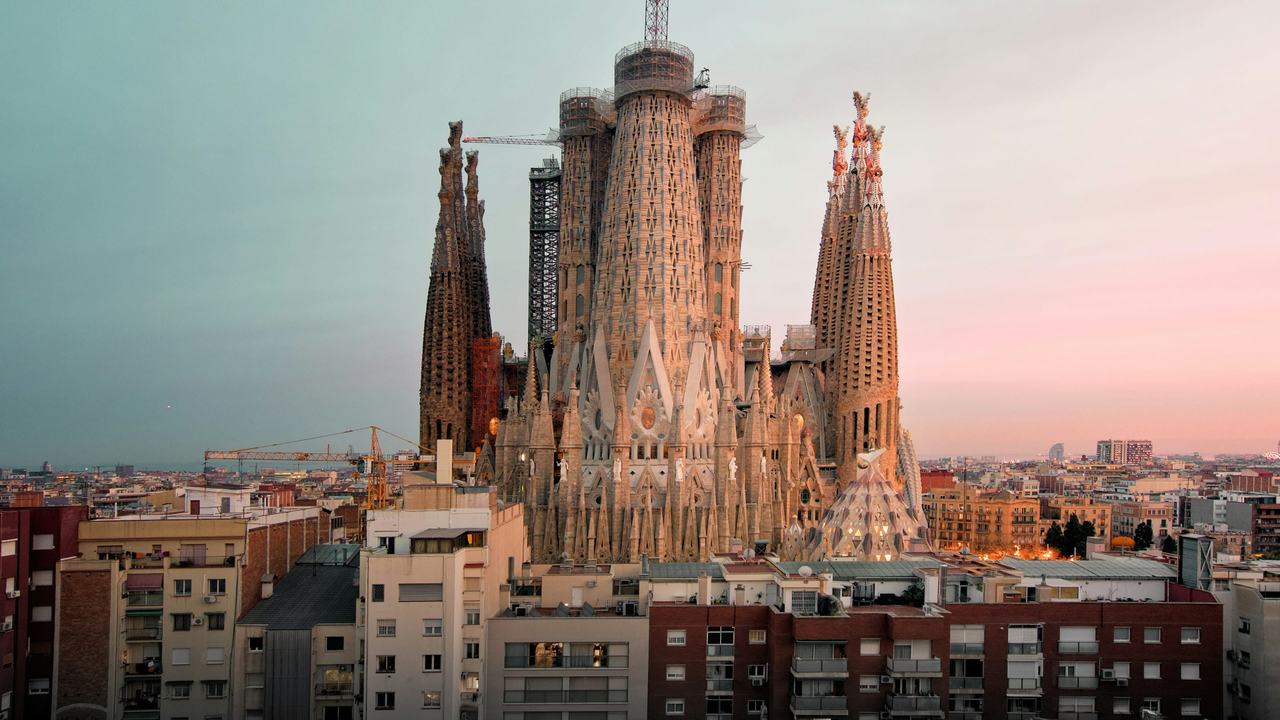
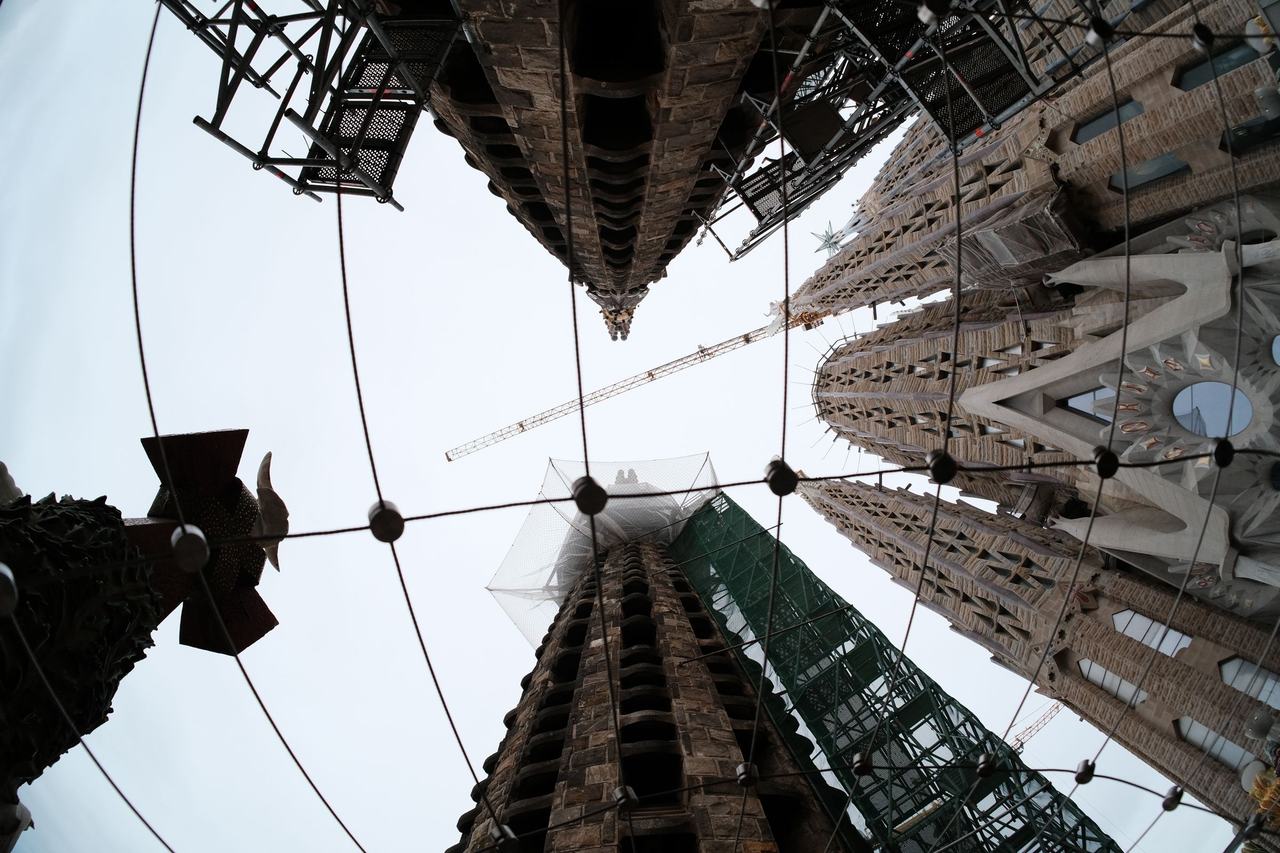
Pope Benedict XVI consecrated the church on November 7, 2010. On October 30, 2025, a section of the central tower was raised to 162.91 meters and the Sagrada Família became the tallest church in the world, ahead of Ulm Minster in Germany. On February 20, 2026, the Tower of Jesus Christ reached its full height of 172.5 meters, in the centenary year of its architect’s death.
It is still not finished. Fourteen of the eighteen towers Gaudí planned are standing, and the main façade is yet to come. When you visit, look up at the vaults of the nave, where the columns branch like trees. Then go down to the museum, where the plaster models are still being pieced back together. Each room explains the other.