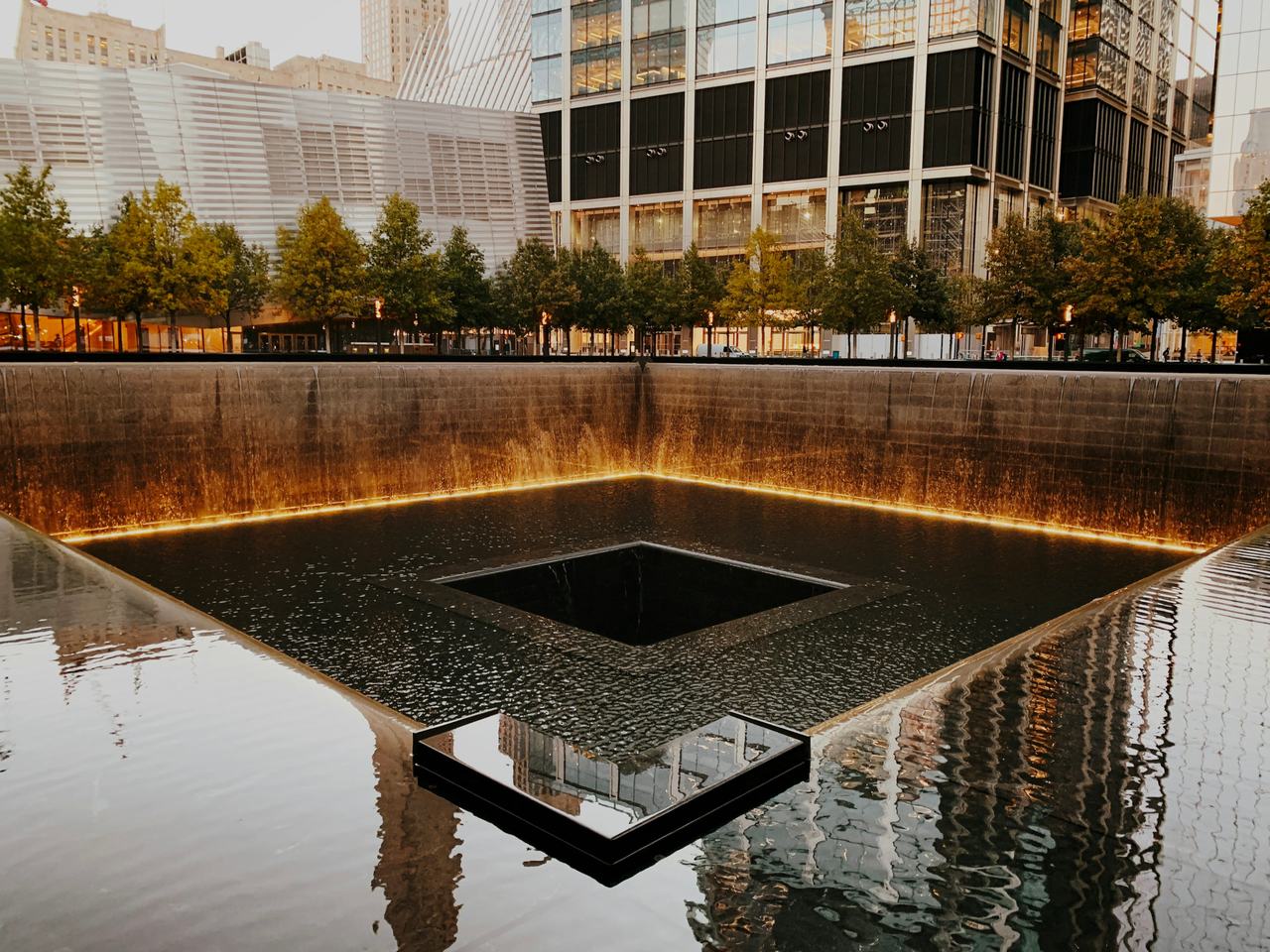
Dedicated on September 11, 2011, ten years after the attacks, the memorial occupies the exact footprints of the Twin Towers: two square pools where water falls into a central void. The museum, beneath the plaza, keeps remnants of the towers and tells the story of the day.
The story
The National September 11 Memorial & Museum occupies the World Trade Center site where the Twin Towers stood before their destruction in the September 11, 2001, terrorist attacks. It commemorates the 2,977 people killed in those attacks and the six killed in the 1993 World Trade Center bombing. Michael Arad and Peter Walker’s memorial design, Reflecting Absence, marks the towers’ footprints with two recessed reflecting pools surrounded by a landscape of swamp white oaks. The memorial opened to the public on September 12, 2011, and the museum beneath the plaza opened in May 2014.
Did you know?
-
The victims’ names around the pools are arranged through “meaningful adjacencies,” rather than a simple alphabetical sequence, preserving connections between those commemorated.
-
Reflecting Absence was the only finalist in the memorial competition that did not follow the master plan’s requirement for buildings to overhang the Twin Towers’ footprints.
On site, look closely
-
The two pools
On the exact footprints of the Twin Towers, two immense square pools receive waterfalls that vanish into a central void.
-
The names
The names of the 2,983 victims of the 2001 and 1993 attacks are cut into the bronze parapets; on each birthday, a white rose is placed there.
-
The Survivor Tree
A pear tree found charred in the rubble was nursed back to health and replanted on the plaza: new branches grow from the scarred trunk.