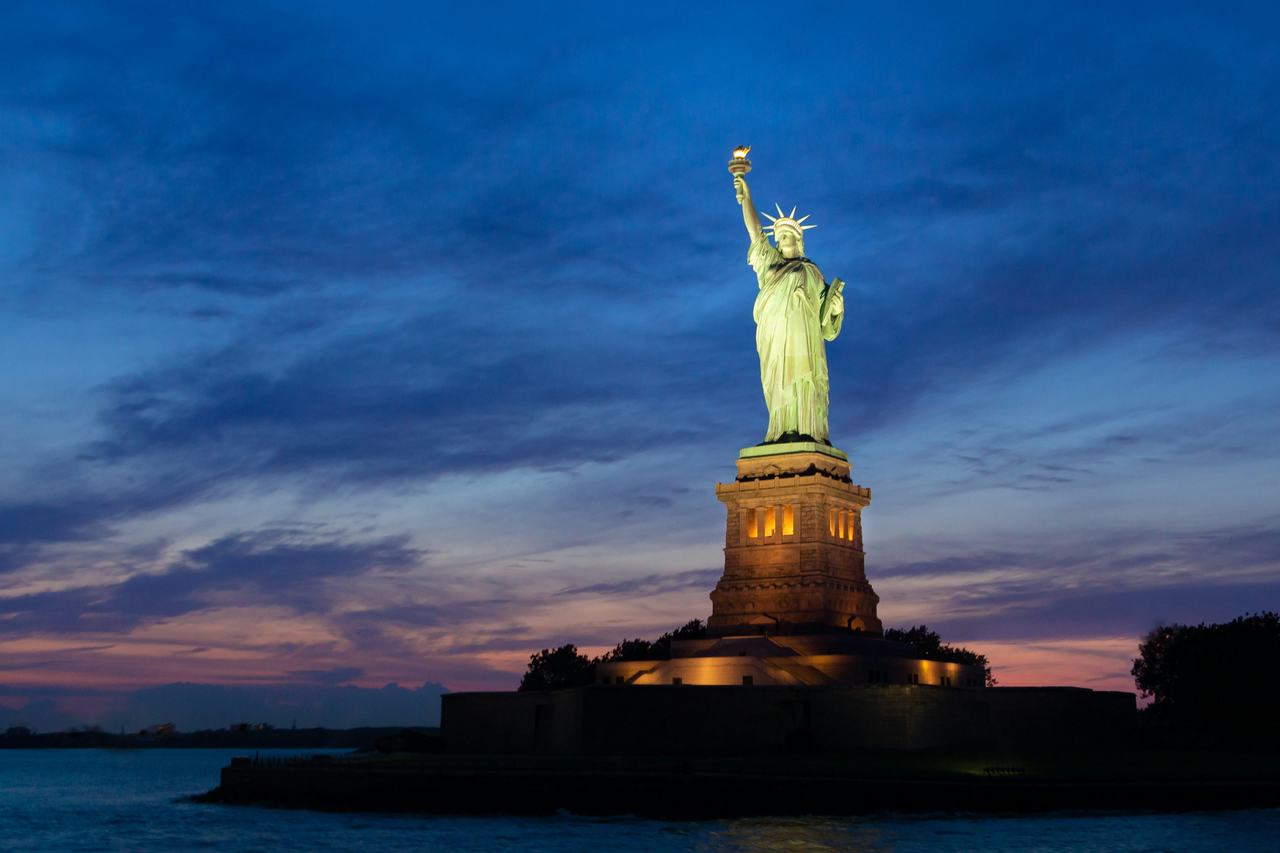
Sculpted in Paris by Auguste Bartholdi on a framework by Gustave Eiffel, the statue crossed the Atlantic in crates before greeting the ships that sailed into New York.
The story
The Statue of Liberty stands on Liberty Island in New York Harbor, a gift from the people of France to the United States. Designed by Frédéric Auguste Bartholdi with a metal framework by Gustave Eiffel, the copper-clad figure was built in France, shipped in crates, and assembled on an American-funded pedestal. President Grover Cleveland presided over its dedication on October 28, 1886. Conceived to celebrate American independence and freedom, the torch-bearing figure became a symbol of welcome to immigrants arriving by sea.
Did you know?
-
At the statue’s feet, a broken chain and shackle commemorate the abolition of slavery after the American Civil War.
-
Before the complete statue reached New York Harbor, its torch-bearing arm was displayed at Philadelphia’s Centennial Exposition in 1876 and then in Manhattan’s Madison Square Park from 1876 to 1882.
On site, look closely
-
The date on the tablet
The tablet she holds in her left hand bears the inscription JULY IV MDCCLXXVI: July 4, 1776, the day of the Declaration of Independence.
-
The broken chain
At her feet lies a broken chain, almost invisible from the ground: Liberty steps forward as she frees herself from her shackles.
-
The original torch
The flame you see today dates from 1986. The original, replaced during the centennial restoration, is on display in the island’s museum.