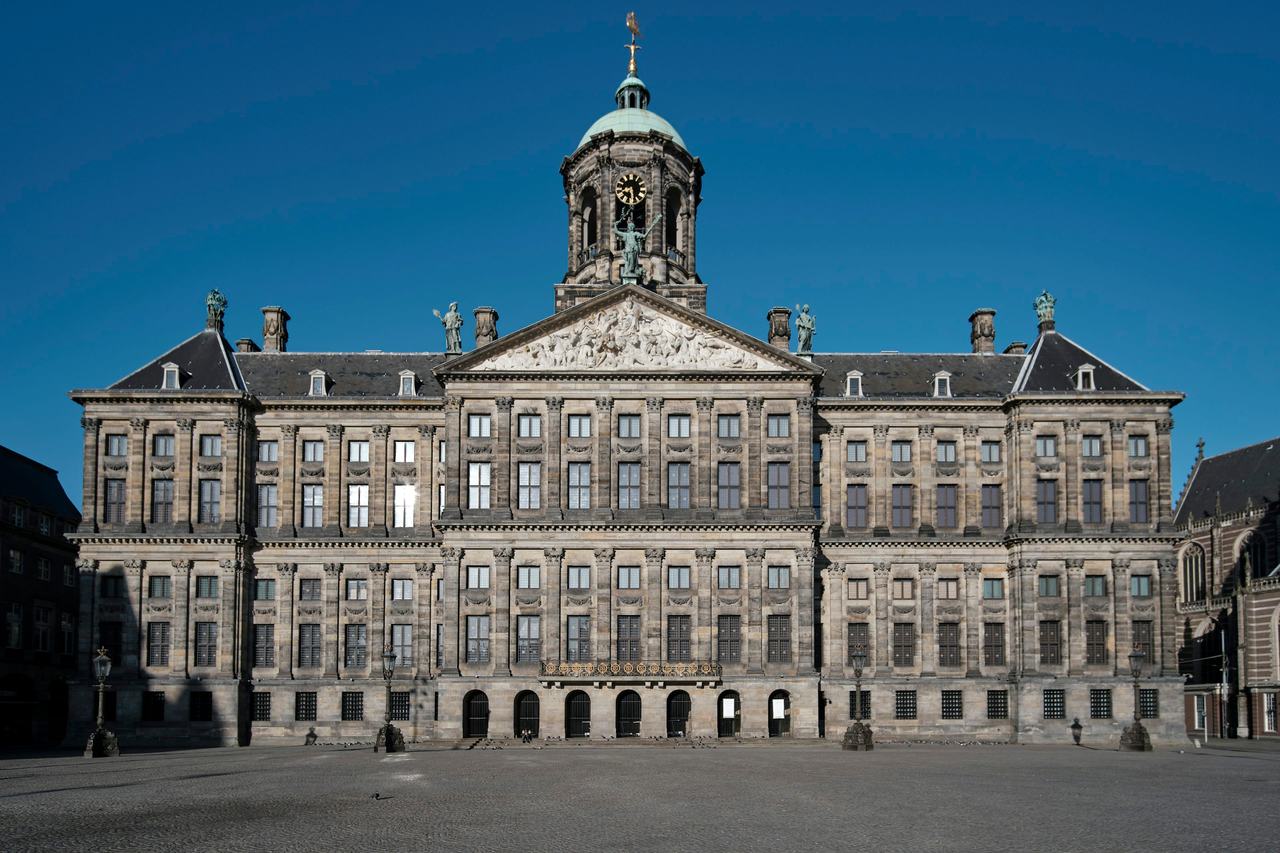
Built by Jacob van Campen as the city hall and inaugurated in 1655, the building became a royal palace in 1808 under Louis Bonaparte. The king still uses it for receptions; the rest of the time its marble halls are open to visitors.
The story
The Royal Palace of Amsterdam began as a city hall, built between 1648 and 1665 to a design by Jacob van Campen and inaugurated in 1655 while work continued. Its Dutch Classicist architecture gives a clear, ordered framework to sculptural decoration celebrating civic government and justice. At its center, the Citizens’ Hall presents the universe in miniature, with marble maps of the Eastern and Western Hemispheres and the northern sky set into the floor. Later converted into a palace, the building serves the Dutch Royal House as a reception palace and also hosts exhibitions.
Did you know?
-
The dome is crowned by a weather vane shaped like a cog ship, an old symbol of Amsterdam.
The original plan called for eight statues representing the directions of the compass, but these were never installed.
-
Rembrandt painted The Conspiracy of the Batavians under Claudius Civilis for the city hall, but it did not remain there: it was either rejected or withdrawn by the artist after a disagreement. Jurriaen Ovens was then asked to complete a replacement in four days using designs by Govert Flinck.
On site, look closely
-
The Citizens’ Hall
Beneath a ceiling nearly thirty meters high, the marble floor is inlaid with maps of the two hemispheres and the starry sky.
-
A town hall turned palace
Built in the 17th century as the town hall of Europe’s richest city, it became a royal palace under Louis Bonaparte in 1808.
-
Atlas on the gable
At the top of the rear facade, a statue of Atlas carries the heavens on his shoulders: look up from the street.