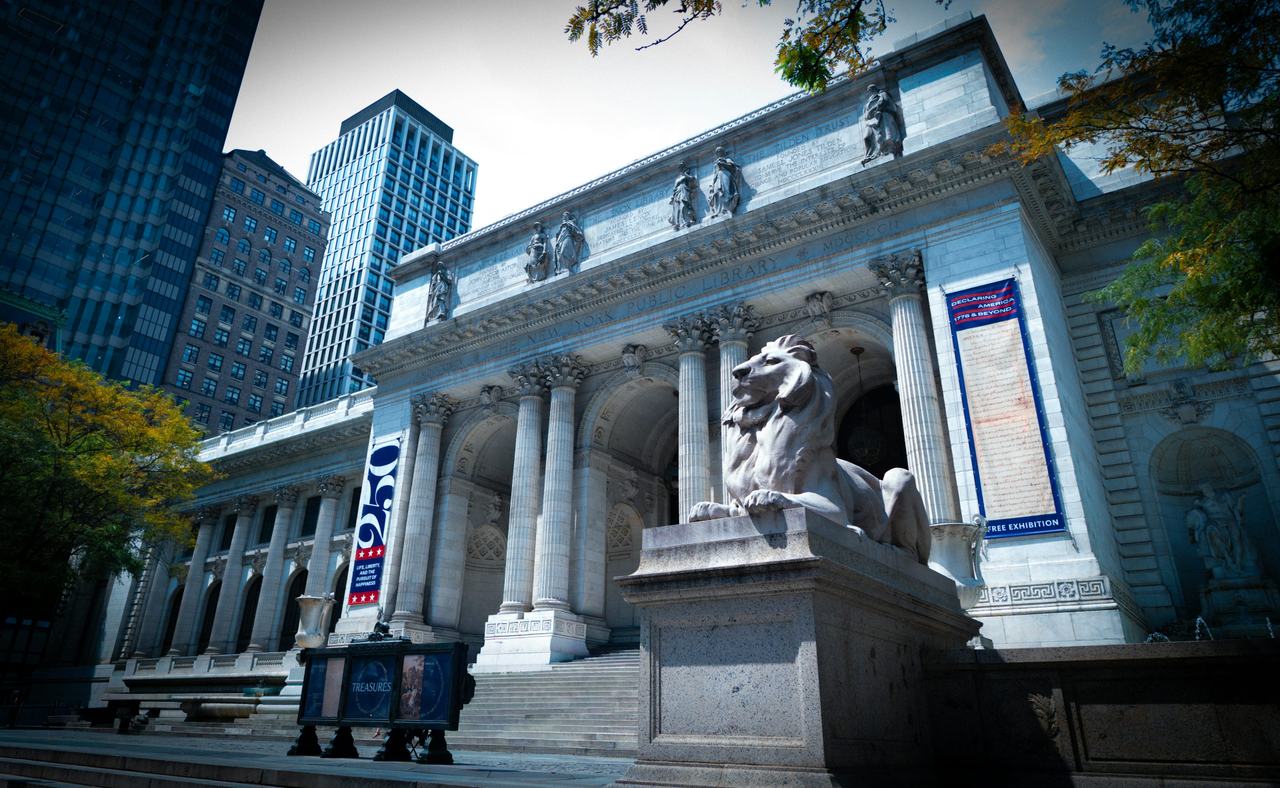
Opened in 1911 on the site of a former water reservoir, the library by architects Carrère and Hastings is a Beaux-Arts marble palace that anyone can walk into.
The story
The New York Public Library’s Fifth Avenue flagship opened on May 23, 1911, on the former site of the Croton Reservoir, bringing together the functions of the Astor and Lenox Libraries. Designed by Carrère and Hastings, its Beaux-Arts marble facade and lion-guarded entrance lead to reading rooms planned around the practical task of delivering books to readers. The library’s first director, John Shaw Billings, proposed the organizing idea: a vast reading room above seven floors of book stacks. Storage expanded beneath neighboring Bryant Park in 1991, and a later restoration supported by Stephen A. Schwarzman’s gift led to the building being named for him.
Did you know?
-
Parts of the Croton Reservoir survive within the library, preserving traces of the water infrastructure that occupied the site before the books arrived.
-
Carrère and Hastings won the design competition in 1897 while still relatively unknown.
Busts of both architects stand at the bottoms of Astor Hall’s two staircases.
On site, look closely
-
Patience and Fortitude
The two lions by the steps, in Tennessee marble, owe their nicknames to Mayor Fiorello La Guardia: in the 1930s, those were the qualities he wished New Yorkers to have to get through the Great Depression.
-
The great reading room
The Rose Main Reading Room is 297 feet long and 78 feet wide, under a ceiling 52 feet high. Visitors are let in at set times, given by the library.
-
The vanished reservoir
The building stands on the site of the Croton Reservoir, which supplied the city with water. Remnants of its walls still survive inside.