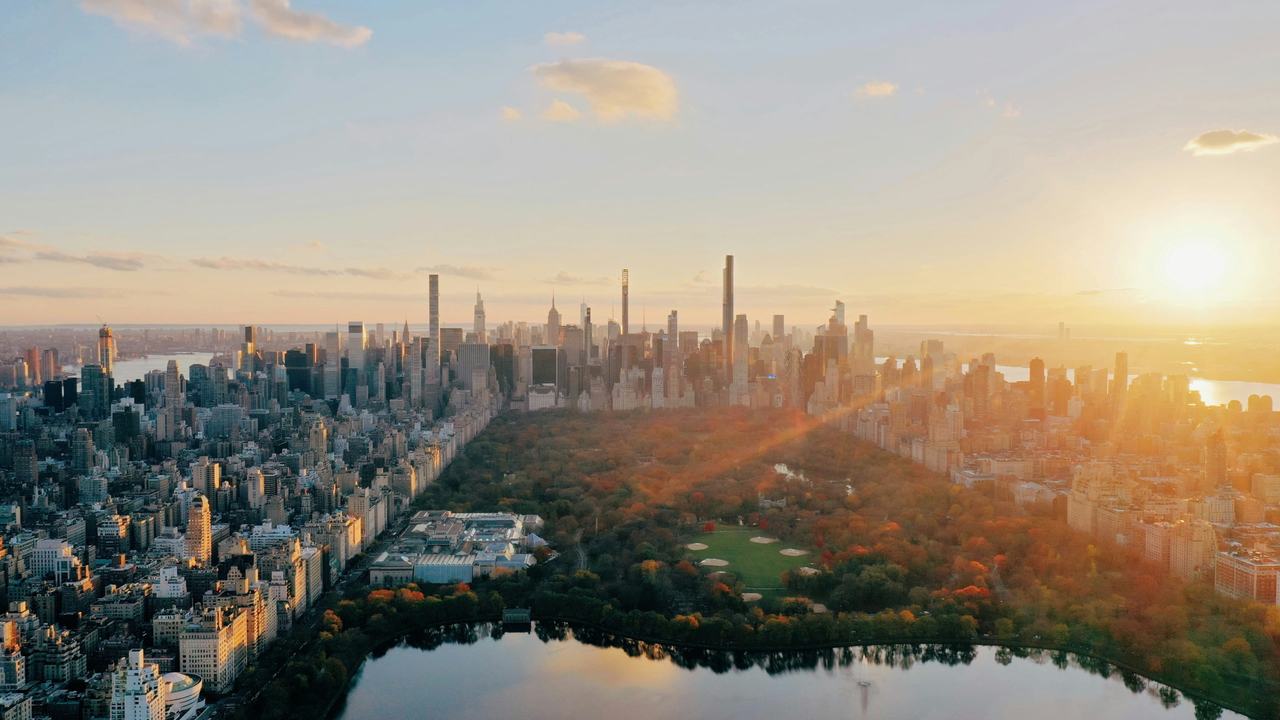
Designed by Frederick Law Olmsted and Calvert Vaux and opened in stages from 1858, Central Park stretches two and a half miles through the heart of Manhattan. Its meadows, lakes and bridges were conceived as countryside in the middle of the city.
The story
Central Park covers 843 acres between Manhattan’s Upper East Side and Upper West Side, its meadows, woodlands, and lakes forming a deliberately constructed landscape. Frederick Law Olmsted and Calvert Vaux won the park’s design competition in 1858 with their “Greensward Plan,” and the first areas opened to the public later that year. Creating the park displaced existing communities, including the majority-Black settlement of Seneca Village, whose land was seized through eminent domain and whose buildings were demolished. Completed in 1876, the park later experienced periods of decline; the Central Park Conservancy, founded in 1980, began restoring many of its landscapes and structures.
Did you know?
-
The park’s eight lakes and ponds were created artificially by damming natural seeps and flows—a reminder that even its apparently natural scenery was engineered.
-
Central Park received two distinct heritage designations
National Historic Landmark district in 1963 and New York City scenic landmark in 1974.
On site, look closely
-
Bethesda Terrace
Two ornate staircases lead down to the Angel of the Waters fountain, sculpted by Emma Stebbins, at the edge of the lake.
-
Strawberry Fields
Near the West 72nd Street entrance, a mosaic bearing the word “Imagine” honors John Lennon, who lived just across the street.
-
Bow Bridge
This arched cast-iron bridge crosses the lake lightly; it offers one of the finest views of the city’s buildings through the trees.