



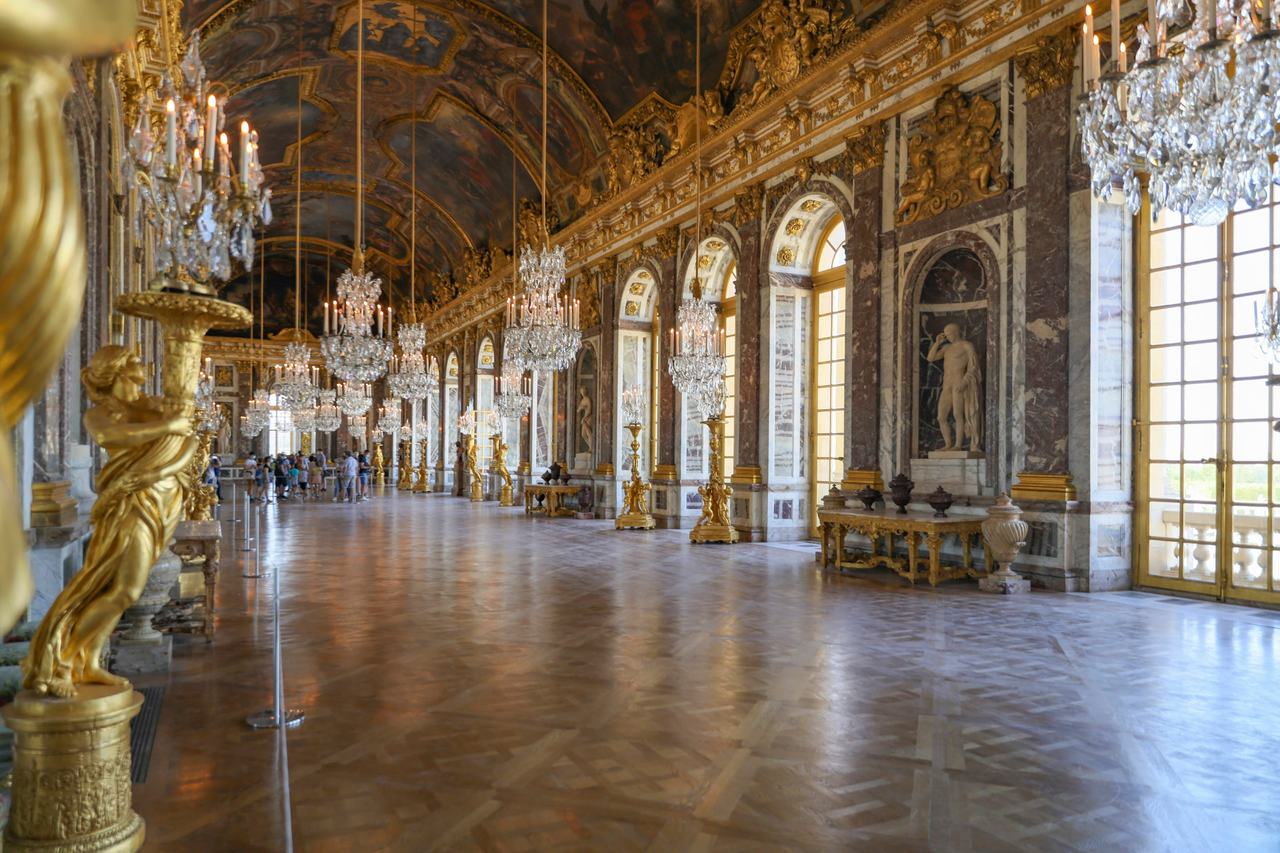
Louis XIV turned his father’s hunting lodge into an immense palace and moved the court there in 1682: the Hall of Mirrors, the State Apartments and Le Nôtre’s gardens stretching as far as the eye can see.
The story
The Palace of Versailles began in 1623 as a modest hunting retreat built for Louis XIII in brick and stone. Louis XIV transformed it into a palace intended to glorify the French monarchy, bringing successive courtyards and wings into a unified composition of classical architecture. From May 6, 1682, until October 6, 1789, it was the permanent seat of the king, court, and government, except during the Regency of 1715–1723. Once the principal residence of Louis XIV, Louis XV, and Louis XVI, the palace now houses a national museum in part of its former royal interiors.
Did you know?
-
Louis XIII’s original retreat had no apartments for women.
His mother, Marie de’ Medici, and his wife, Anne of Austria, visited but did not stay overnight.
-
The position of Louis XIV’s bed corresponds to the site of the central salon in Louis XIII’s much smaller residence.
On site, look closely
-
The 357 mirrors
In the Hall of Mirrors, seventeen arcades of mirrors answer the seventeen windows opening onto the gardens: 357 mirrors in all, an unheard-of luxury in the 17th century.
-
The bedchamber at the center
Louis XIV’s bedchamber sits at the exact middle of the palace, facing the rising sun. The king’s whole day, from rising to going to bed, was played out there in public.
-
The Grand Canal perspective
From the terrace, the eye runs to the far end of the Grand Canal, whose main branch measures 1,670 meters (just over a mile). The garden was designed for this line.