



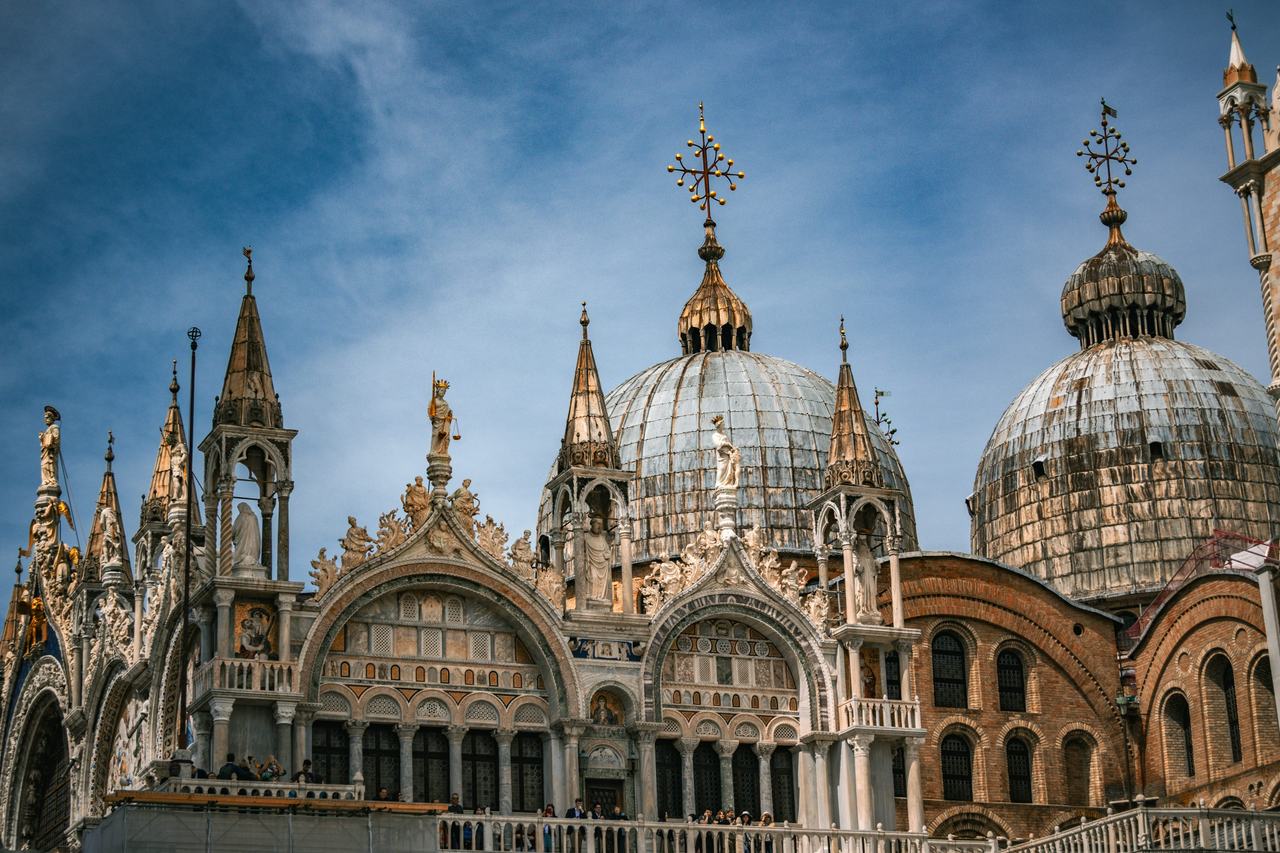
Raised to house the relics of Saint Mark, brought from Alexandria in 828, the present basilica was begun around 1063 and consecrated in 1094. The doges’ chapel for centuries, it has been Venice’s cathedral only since 1807.
The story
St. Mark's Basilica stands at the eastern end of Piazza San Marco, attached to the Doge's Palace, and houses the relics of Venice's patron saint. The present church, the third on the site, was probably begun in 1063, taking the Church of the Holy Apostles in Constantinople as its model while adapting its design to Venetian state ceremonies. Its brick walls were gradually clad in rare marbles and precious stones, chiefly during the thirteenth century, while gold-ground mosaics spread across the domes, vaults, and upper walls. Built as a state sanctuary and long serving as the doge's chapel, it became the cathedral of the Patriarch of Venice in 1807.
Did you know?
-
The four ancient bronze horses placed above the entrance were among the treasures taken from Constantinople following Venetian participation in the Fourth Crusade.
-
The mosaics reflect eight hundred years of changing artistic styles; some were made from preparatory drawings by Titian, Tintoretto, and Paolo Veronese.
On site, look closely
-
The Pala d’Oro
Behind the high altar, this altarpiece of gold and enamel measures 3.34 by 2.12 meters (about 11 by 7 feet) and carries nearly two thousand precious stones.
-
The horses
The four gilded bronze horses brought from Constantinople after 1204 are sheltered inside; those on the loggia are copies.
-
The Tetrarchs
Set into the outer wall of the treasury, four porphyry emperors stand in an embrace: these are the Tetrarchs.