



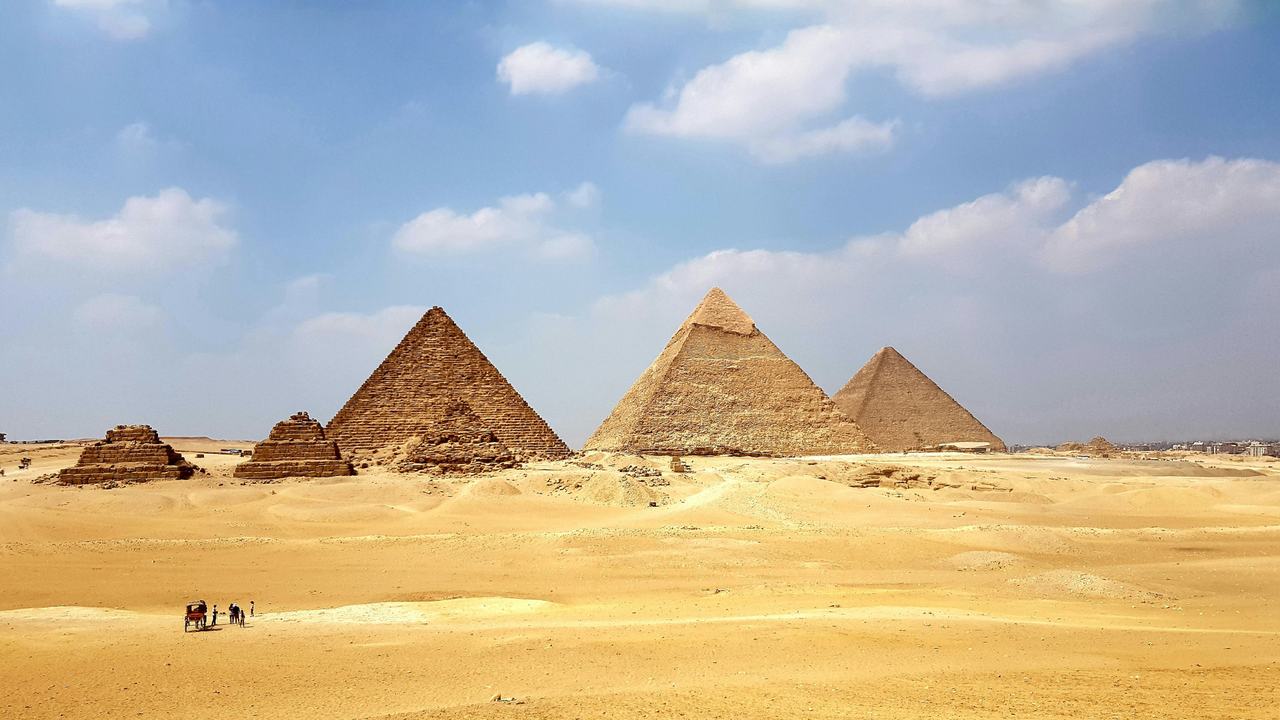
Three kings of the Fourth Dynasty, Khufu, his son Khafre and his grandson Menkaure, had their tombs built here. The Great Pyramid, the oldest and the largest, remained the tallest human-made structure for more than 3,700 years.
The story
The Pyramids of Giza stand at the edge of Egypt’s Western Desert, forming a royal necropolis built during the Fourth Dynasty, around 2600–2500 BC. Its three principal pyramids were built for Khufu, Khafre, and Menkaure, with temples and causeways linking the royal tombs to places of ritual. Smaller queens’ pyramids, cemeteries, the Great Sphinx, and the remains of a workers’ village reveal a complex extending far beyond the three familiar silhouettes. In 1979, the necropolis became part of the UNESCO World Heritage Site encompassing Memphis and its pyramid fields.
Did you know?
-
Khafre’s pyramid can appear larger than Khufu’s because it stands on higher ground and has steeper sides; it is actually smaller in both height and volume.
-
Excavators found intact wooden ships in two pits south of Khufu’s pyramid.
One was restored and displayed beside the pyramid before being moved to the Grand Egyptian Museum.
On site, look closely
-
The top of Khafre
The pyramid of Khafre keeps part of its smooth limestone casing at its top; the Great Pyramid has kept a few blocks at its base.
-
Twenty-seven feet shorter
The Great Pyramid once stood 146.6 meters (481 feet); stripped of its casing, it now stands 138.5 meters (454 feet).
-
The Sphinx
The Great Sphinx is part of the same funerary complex as the three pyramids.