



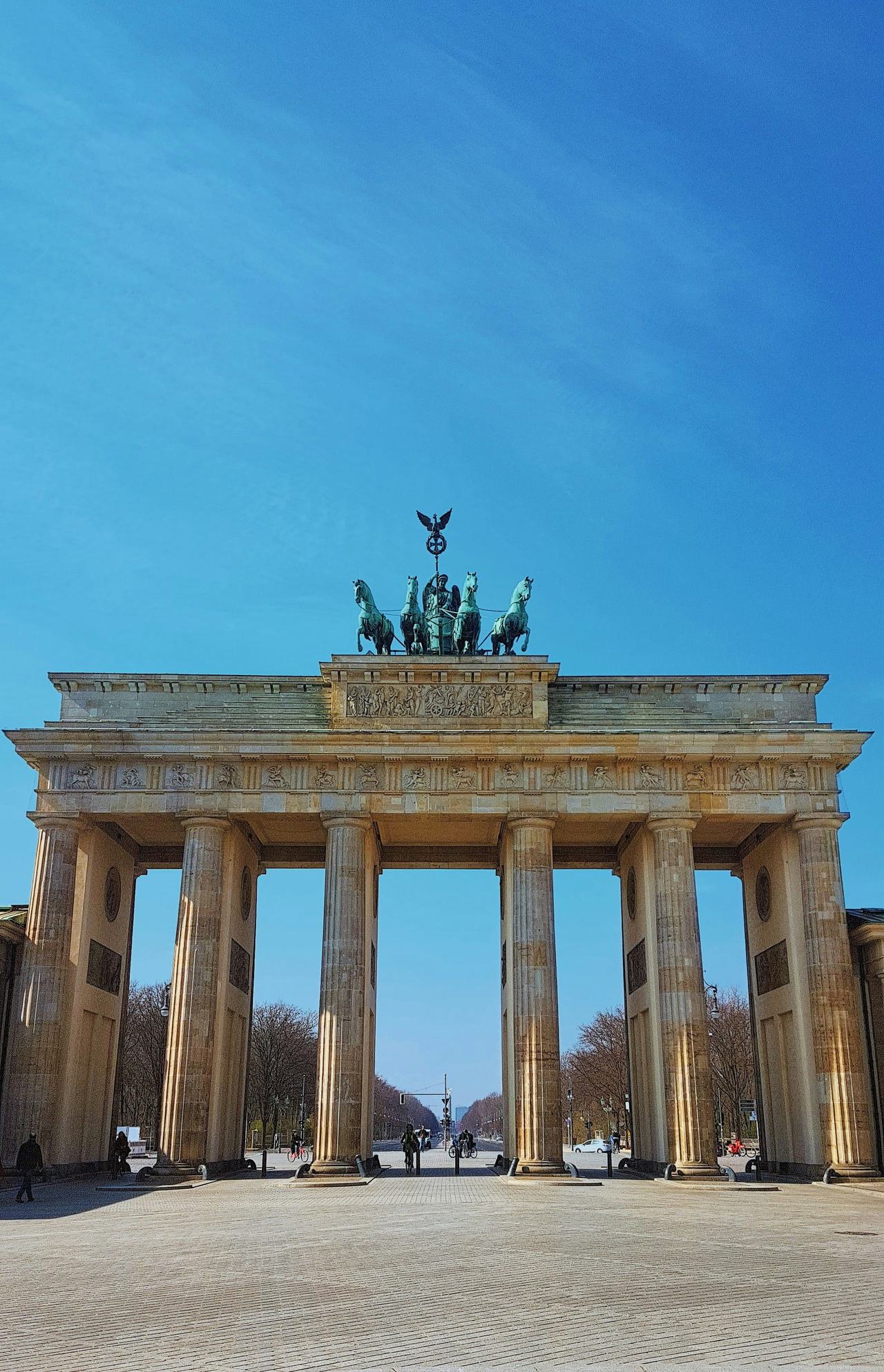
Built from 1788 to 1791 by Carl Gotthard Langhans, Berlin’s first Greek Revival building, the gate stayed shut, against the Wall, for nearly three decades. It reopened on December 22, 1989, before some hundred thousand people.
The story
Brandenburg Gate stands at the western edge of Pariser Platz, where it was built between 1789 and 1793 on the orders of Prussian King Frederick William II. Architect Carl Gotthard Langhans modeled it on the Propylaea, the gateway to the Acropolis in Athens, while the crowning quadriga follows a design by sculptor Johann Gottfried Schadow. Intended to proclaim royal authority, the gate later became a symbol of division when it stood in East Berlin immediately beside the boundary with West Berlin during the Cold War. Damaged during World War II and restored by 1958, it has symbolized the overcoming of Germany’s and Europe’s division since 1990.
Did you know?
-
The name originally chosen for the monument was “Gate of Peace,” presenting Frederick William II as a peacemaker after Prussian troops intervened in the Netherlands.
-
It is the only surviving gate of the 18 that once served Berlin.
On site, look closely
-
The Quadriga
Johann Gottfried Schadow’s four-horse chariot, set in place in 1793, was carried off to Paris by Napoleon in 1806 and came back only in 1814.
-
Eighty-five feet high
The gate is 26 meters (85 feet) high, 65.5 meters (215 feet) long and 11 meters (36 feet) deep.
-
The Athenian model
Its Doric columns follow the design of the Propylaea, the entrance to the Acropolis of Athens.