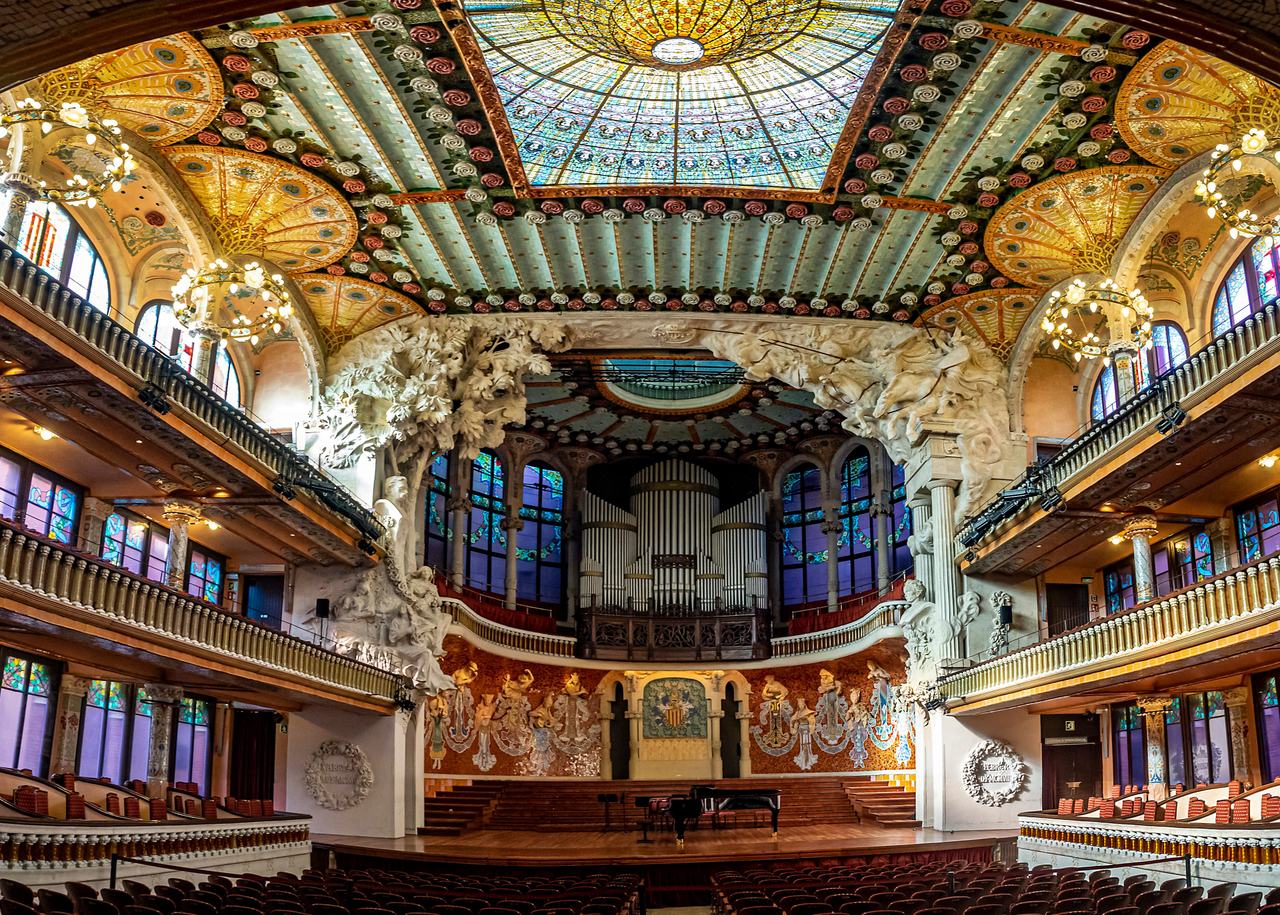
Built from 1905 to 1908 by Lluís Domènech i Montaner for the Orfeó Català choral society, the Palau is a manifesto of Catalan Modernisme. It has been a World Heritage Site since 1997.
The story
The Palau de la Música Catalana was built between 1905 and 1908 as the home of the Orfeó Català choral society, with funding from Catalan industrialists and financiers. Architect Lluís Domènech i Montaner combined large glass walls with sculpture, mosaics, stained glass, and wrought iron, making the decorative arts integral to the concert hall. Since its inauguration, the building has hosted orchestral concerts, choral performances, recitals, theater, and political gatherings. Restoration and expansion beginning in the 1980s adapted it for continued use, and UNESCO inscribed it on the World Heritage List in 1997.
Did you know?
-
In 1960, authorities banned a planned performance of the Catalan anthem Cant de la Senyera at the last moment, but audience members stood and sang it anyway while leaflets opposing Franco were distributed. The ensuing crackdown included the arrest of future Catalan president Jordi Pujol.
-
One phase of the expansion added a six-story building whose corner tower has a base sculpted in the shape of a giant palm tree.
On site, look closely
-
The glass sun
On the ceiling of the hall, Antoni Rigalt’s great skylight drops into an inverted dome, gold at the center, blue around it: the sun and the sky.
-
The eighteen muses
At the back of the stage, eighteen young women in a semicircle, known as the muses, surround the musicians.
-
The Ride of the Valkyries
The arch over the stage, sculpted by Dídac Masana and Pablo Gargallo, sets the bust of Anselm Clavé, a figure of Catalan folk song, on the left against Wagner’s Ride of the Valkyries on the right.