



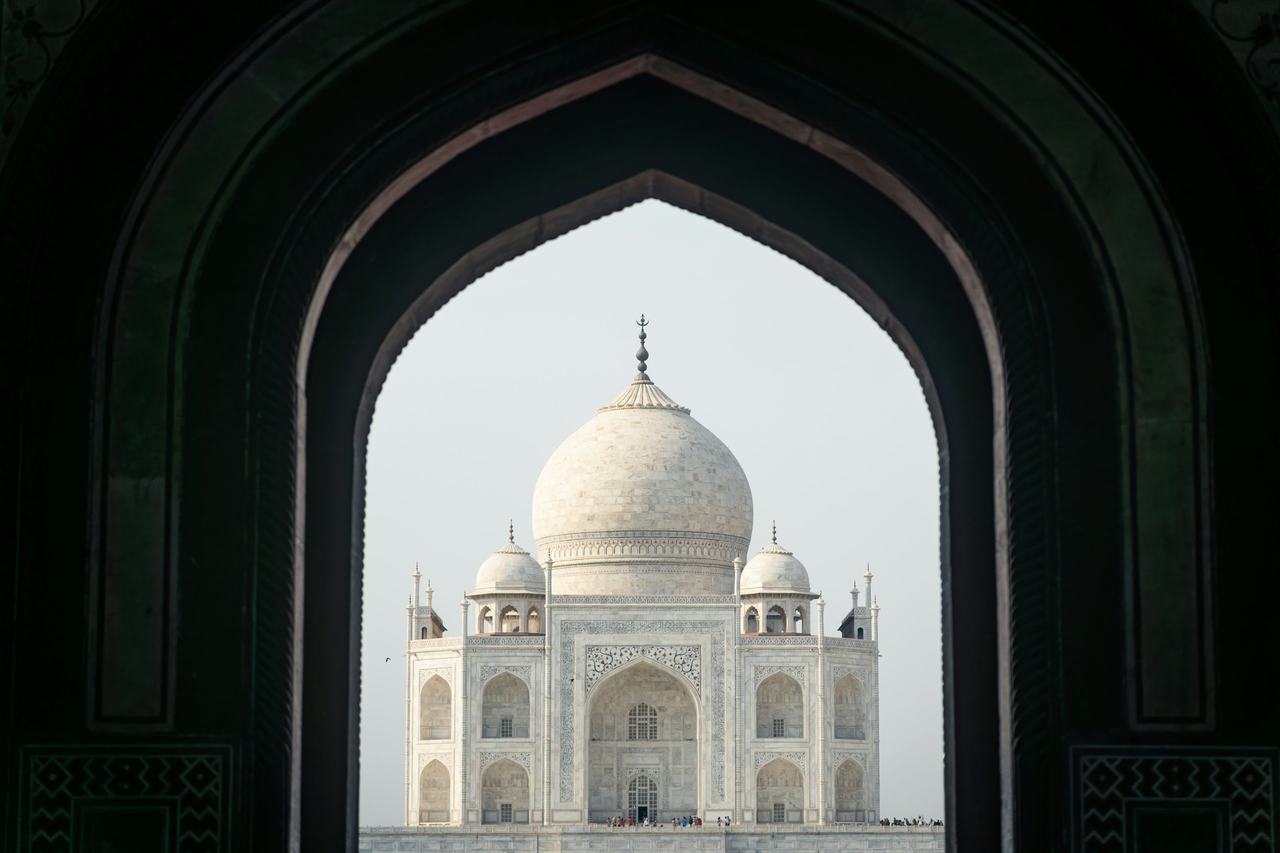
Shah Jahan raised it on the bank of the Yamuna in memory of Mumtaz Mahal, who died in 1631: twenty years of work for India’s most famous monument.
The story
The Taj Mahal stands on the right bank of the Yamuna in Agra, where Emperor Shah Jahan commissioned it in 1631 as the tomb of his wife, Mumtaz Mahal. Construction began in 1632 under a board of architects led by Ustad Ahmad Lahori; the mausoleum was completed in 1648, with work on the surrounding complex continuing until 1653. Its white marble, inlaid with semiprecious stones, contrasts with the red sandstone of the accompanying buildings, while formal gardens organize the approach to the tomb. The mausoleum also houses Shah Jahan’s tomb, bringing the emperor and the wife he commemorated together within the same monument.
Did you know?
-
The site previously held a mansion belonging to Raja Jai Singh I, who exchanged the property with Shah Jahan for a large palace in central Agra.
-
Shah Jahan held a ceremony at the mausoleum on February 6, 1643, to observe the twelfth anniversary of Mumtaz Mahal’s death—before the building was complete.
On site, look closely
-
Letters that grow
Around the great arches, the calligraphy gets larger as it rises: seen from below, it looks the same size all the way up.
-
Leaning minarets
The four minarets lean very slightly outward: in an earthquake, they would fall away from the tomb.
-
A marble that changes
Pinkish at dawn, dazzling at noon, golden at sunset: the marble takes on the color of the light.